I have been studying and observing a nearby Pheidole megacephala cluster, which occupies an irregular area of around 1.1 ha. I usually come early in the morning (around 630 am), when the colony is starting to wind down due to the incoming heat, and then check again at dusk, when the ants start slowly pushing out again for a night of work.
I’ve been concentrating on the periphery of the cluster, where interactions with other ants mostly occur, and over the last two weeks there has been a gradual spread as the P. megacephala started controlling more of the daily baits. I saw no active conflict during this expansion, other than one instance where some workers killed a Crematogaster ant whose colony had probably been evicted by the former.
But when I came to one of the peripheral locations this morning, I was surprised to find long lines of large ants moving along the borders of the concrete pedestrian walkway, instead of the smaller P. megacephala minors in their foraging lines. There were reproductives (gynes?) mixed in among the workers, and I realized I had stumbled on a moving (probably polygynous) Solenopsis invicta colony (see Image 2 below).
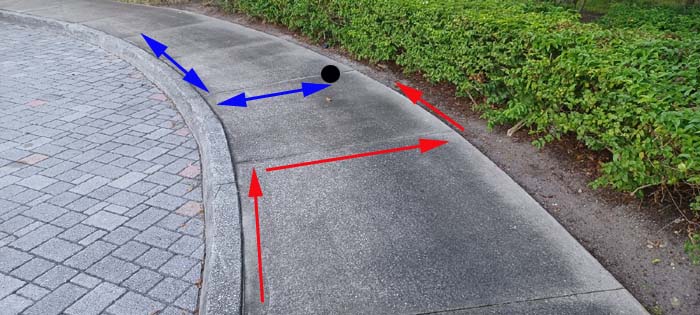
The fire ants were coming up from the south and moving to nest holes under the vegetation. The interesting thing was that the P. megacephala had been controlling baits about 5 meters south of where I now found them, although the actual node was located where the fire ants were now creating their new home.
At first, I could not find any interactions between the two, but along the border of the cluster where P. megacephala workers milled around, I finally found scenes of conflict (indicated by a black circle in Image 2).
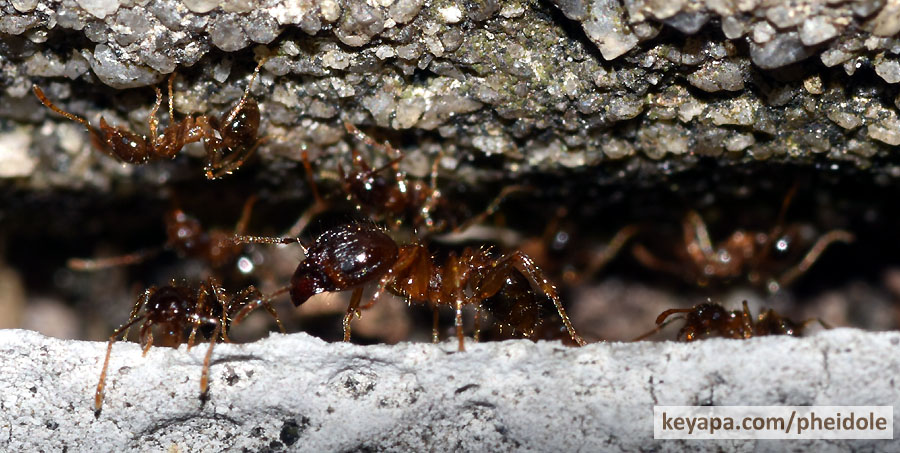
Two fire ants showed signs of combat, with one dragging along the head of a P. megacephala minor worker, while the other fire ant had been dismembered some time earlier and was likely dead (see Image 4 below).
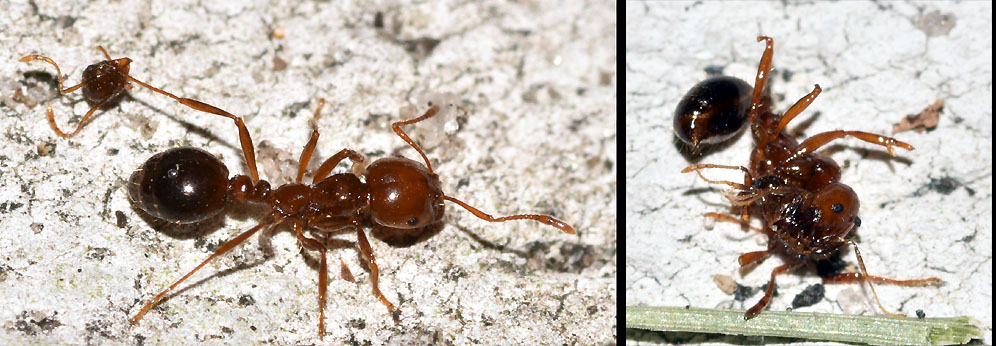
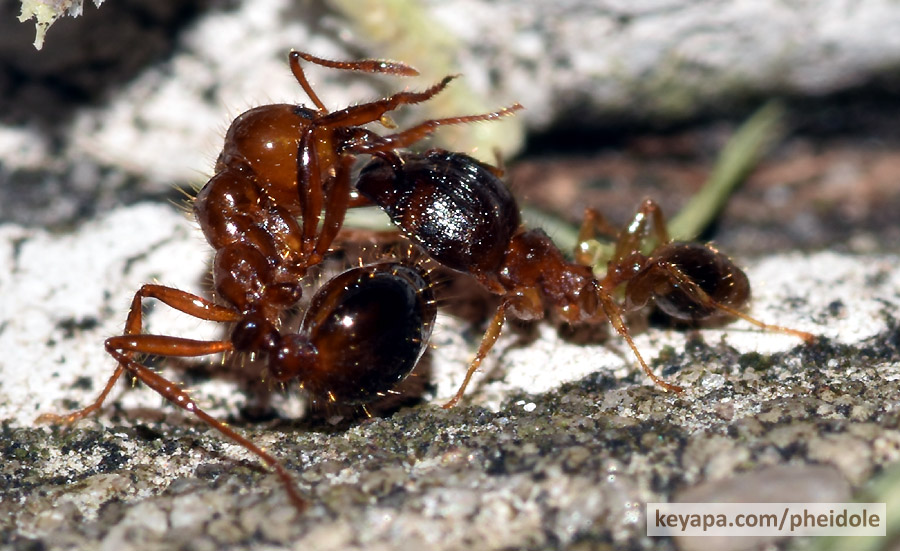
In the same vicinity, a P. megacephala major grappled with a third passing fire ant (see Images 1 and 5), which tried to sting the soldier.
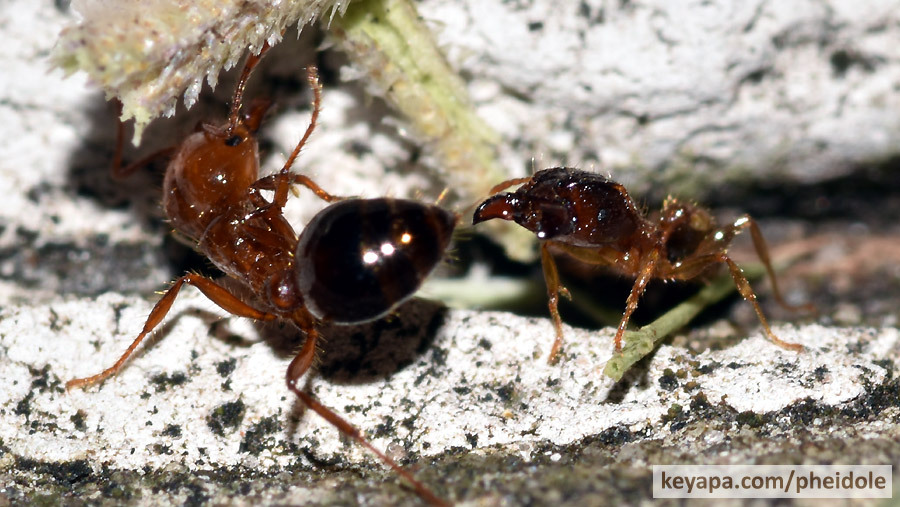
I also found a congregation of P. megacephala killing a 4th fire ant, which had been spread-eagled and decapitated by the surrounding soldiers while I took pics (I admit, I kinda chuckled when I saw a P. megacephala minor hold aloft the decapitated head, as if in triumph). The head and body were taken into the nest by the P. megacephala as prey (see Image 6).

Other than these, I did not see any other combat. The fire ants ignored the P. megacephala lurking in the border, while the latter did not actively obstruct the fire ant migration lines, choosing instead to capture and kill any fire ants that came too close.
This is only the second time that I’ve seen P. megacephala engage in combat against another group of ants in the years I’ve known of the species , and it will be interesting to see what kinds of interactions might happen going forward.

Leave a Reply