
The factors that determine plant species diversity in grasslands is still being explored. Some of the factors commonly cited include atmospheric nitrogen deposition and climate. A new study indicates that photosynthetically active radiation (PAR) might be another major determinant of species diversity in a grassland environment.
Previous studies have shown that photosynthesis is positively correlated with increasing PAR, but only at low to moderate PAR. When light intensity exceeds optimal conditions for photosynthesis, plants suffer abiotic stress and physiological damage. This is due to the formation of intermediates in the process that cause damage to the photosynthetic apparatus, and results in photoinhibition (Yamori, 2016).

Different species of plants have different levels of optimal PAR, and different sensitivities to photodamage. For example, species could vary in whether they have or do not have various light stress protection mechanisms, such as chloroplastic Reactive oxygen species (ROS) scavenging, chloroplast and stomatal movement, and anthocyanin production. These difference could result in changes in species diversity in the landscape.
A new study this year examined species diversity in 150 natural and semi-natural grasslands on six continents, with elevation ranges from 0 to 4400 masl (meters above sea level). They measured PAR as well as UV-B radiation at different elevations, and correlated this with species diversity and plant groupings (Spohn et al, 2026). The various plant groups were grasses, forbs (ie. all non-graminoid plants), as well as other graminoids such as sedges (family Cyperaceae) and rushes (family Juncaceae). What they found was interesting, and highlights the importance of factoring in PAR when projecting the future effects of climate change on diversity.
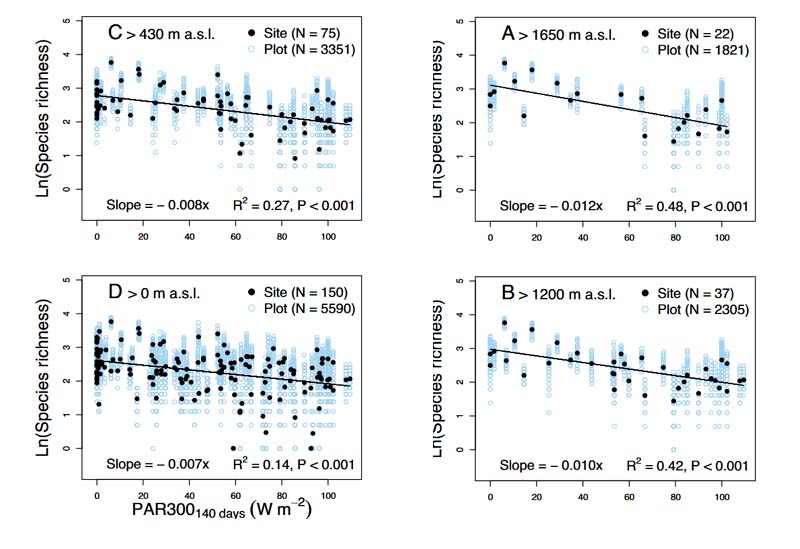
Specifically, they found the following:
- There is a decrease in species richness with increasing PAR. Species that are sensitive to increasing PAR are weeded out of the populations.
- Plants groups were affected differently, with the species richness of forbs, rushes and sedges being negatively affected the most. Grasses were only slightly negatively affected (and only at higher elevations), while legumes did not seem to be affected by PAR levels.
- PAR seems to be a major factor that affects species diversity in grasslands. In fact, the study revealed that species diversity was more strongly affected by PAR than UV-B radiation, mean annual temperature (MAT), mean annual precipitation (MAP), the aridity index, atmospheric nitrogen deposition, or plant biomass.
- The strength of the negative relationship between species diversity and PAR increased as elevation increased. This makes sense because sunlight at higher elevations does not have to travel through as much of the atmosphere, which can dissipate it through scattering, absorption, and reflection.
The differential sensitivity of plant groups to PAR and the larger effect of PAR in higher mountain elevations has important implications for plant species. It means that for certain plant groups (such as forbs, sedges and rushes) there are limits as to how high they can “climb uphill” to escape deleterious changes in their current habitat that are happening due to climate change. Many of these plant species have thus been said to be “riding the elevator to extinction” (Watts et al, 2022), a catchy phrase that unfortunately seems to have more than a nugget of truth in it.
Literature Cited and References:
M. Spohn, C.A. Arnillas, J.D. Bakker, E.T. Borer, K.A. Bråthen, M.W. Cadotte, C. Carbutt, J.A. Catford, M.E. DuPre, C. Dwyer, N. Eisenhauer, C. Estrada, N. Hagenah, S. Haider, K.E. Harms, Y. Hautier, E.I. Hersch-Green, J.M.H. Knops, L. Laanisto, R. Laungani, P. Macek, H. Martinson, J. Millett, M. Pärtel, S.C. Pennings, P.L. Peri, S.A. Power, A.C. Risch, C. Roscher, E.W. Seabloom, N.G. Smith, C. Stevens, R. Virtanen, G.M. Wardle, & P. Zhang (2026). Intense solar radiation constrains plant species richness in global grasslands, Proc. Natl. Acad. Sci. U.S.A. 123 (6) e2527128123, https://doi.org/10.1073/pnas.2527128123
Watts SH, Mardon DK, Mercer C, Watson D, Cole H, Shaw RF & Jump AS (2022) Riding the elevator to extinction: Disjunct arctic-alpine plants of open habitats decline as their more competitive neighbours expand. Biological Conservation. https://doi.org/10.1016/j.biocon.2022.109620
Y. Shi, X. Ke, X. Yang, Y. Liu, X. Hou (2022). Plants response to light stress. J. Genet. Genomics 49, 735–747.
Yamori, W. (2016). Photosynthetic response to fluctuating environments and photoprotective strategies under abiotic stress. J Plant Res 129, 379–395. https://doi.org/10.1007/s10265-016-0816-1
Leave a Reply