
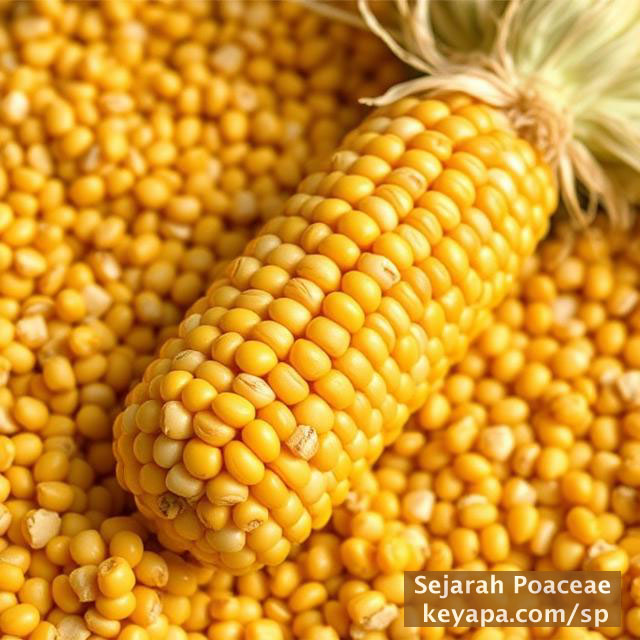
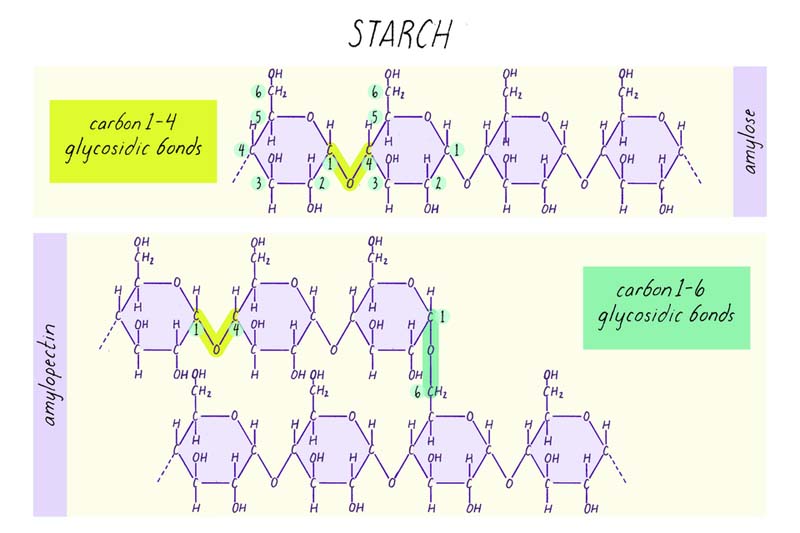
Plants produce glucose using carbon dioxide and water from the environment. This glucose is then used to power cell metabolism and keep plants alive. However, glucose is an osmotically active material, and is hard to store, so plants link together glucose molecules to form a carbohydrate called starch. Starch is compact and insoluble, and is thus perfect for storage of energy until it is needed by the plant. It is the main component of grass endosperm, and is thus the material that we humans mainly ingest when we eat corn (Zea mays), or products made from wheat such as bread (Triticum spp), or meals built on a foundation of grains of rice (Oryza sativa).
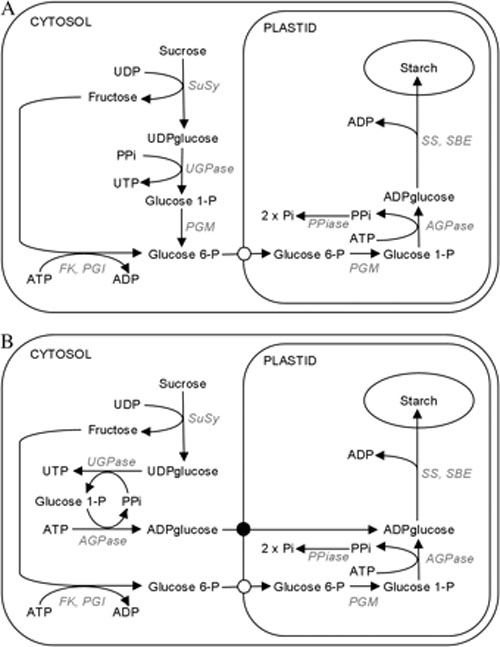
In all plants, the formation of starch occurs in membrane-bound organelles inside cells called plastids. The precursor to starch is called ADPglucose, and it is made by the enzyme AGPase from glucose 1-phosphate.
Amazingly, in the Poaceae, there is a SECOND alternative pathway for starch formation that is found in the cytosol, which is outside the plastids! This is unique to grasses, and its evolution seemed to happen during the initial evolution of the family.
During the evolution of the Poaceae, the last common ancestor of all living grasses experienced something called the ρWGD (“rho whole-genome duplication”). The entire genome of this ancestor to extant grasses was duplicated, with the concomitant differential retention and continued evolution of the duplicated genes. This key event created the vast range of adaptations and traits that we find in grass species today.
It was during this extremely important whole genome duplication event that the genes for the two subunits of a cytosolic AGPase and an ADPGlucose transporter (which moves the ADPGlucose produced by the cytosolic AGPase into the plastids) were developed. These resulted in grasses having BOTH cytosolic AND plastid production of the precursor for starch biosynthesis.

The importance of this second alternative starch biosynthetic pathway can be seen when mutants with inactive cytosolic AGPase or ADPGlucose transporter are studied. In these plants, the seeds produced are shriveled and shrunken and have much less starch, and direct measurements of AGPase activities have confirmed that cytosolic AGPase is much more active than the corresponding plastid AGPase.
The existence and continued preservation of this alternative pathway might be due to the fact that cytosolic production of the precursor ADPGlucose is more efficient compared to when production is in the plastids. This is because each ADPGlucose produced by AGPase uses up an energy molecule called ATP, and for non-photosynthetic plastids, this ATP has to be moved into the plastids through the expenditure of more energy. By producing ADPGlucose in the cytosol where ATP is plentiful, grasses avoid such waste.
The discovery of this second alternative starch biosynthetic pathway that is found nowhere else except in grasses again highlights the amazing capabilities of this plant family. It may also perhaps be a factor as to why the Poaceae have risen to dominance in a crowded and competitive world.
References:
Sylviane Comparot-Moss, Kay Denyer (2009). The evolution of the starch biosynthetic pathway in cereals and other grasses, Journal of Experimental Botany, Volume 60, Issue 9, Pages 2481–2492, https://doi.org/10.1093/jxb/erp141
Takeda-Kimura, Yuri & Moore, Bethany & Holden, Samuel & Morris, Jae & Deb, Sontosh & Sanders, Carly & El-Azaz, Jorge & Barrett, Matt & Lorence, David & Oliveira, Marcos & Havranek, Wynne & Grimwood, Jane & Williams, Melissa & Boston, Lori & Jenkins, Jerry & Plott, Christopher & Shu, Shengqiang & Barry, Kerrie & Goodstein, David & Maeda, Hiroshi. (2026). Genomes of Poaceae relatives reveal key metabolic innovations preceding the evolution of grasses. Science. 393. 10.1126/science.adv0443.
Leave a Reply