

I was in the area, and decided to visit an old site in Kissimmee, FL where I had been reporting the expansion of a large cluster of Imperata cylindrica (cogon grass) since Spring 2021. During the last visit, the cogon grass had managed to go around a large tree blocking its way, and I wanted to see how it was doing now that it had overcome that recent obstacle.
For a history of this series of observations (oldest to most recent):
April 2021
Rapid expansion of an invasive grass as viewed using Google StreetView
December 2021
Update on the rapid expansion of an invasive grass
September 2023
Second Update on the rapid expansion of an invasive grass in Florida
November 2024
An irresistible force meets an immovable object?
December 2025
Breaking the Blockade
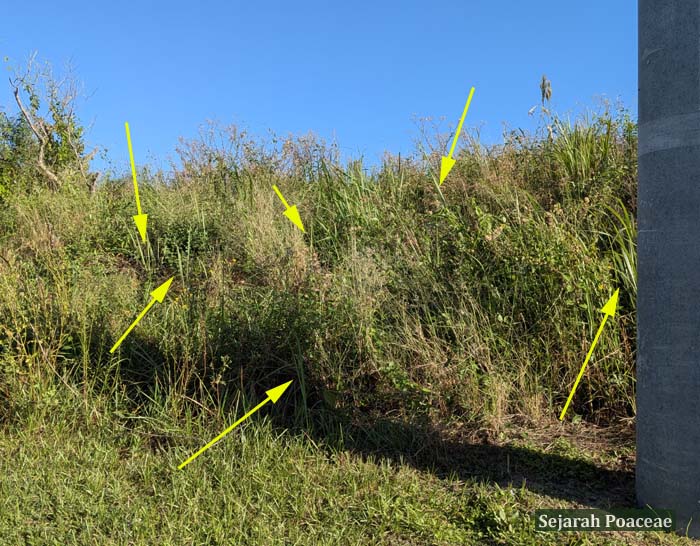
When I visited the cluster this afternoon (October, 2026), the cogon grass had established a much larger presence west of the tree. In December of 2025, around 10 months ago, isolated ramets had made their way around the tree, up to 6.3 meters from the tree center. This time, there were a lot more ramets west of the tree, and some ramets had gone past the pole to the west.
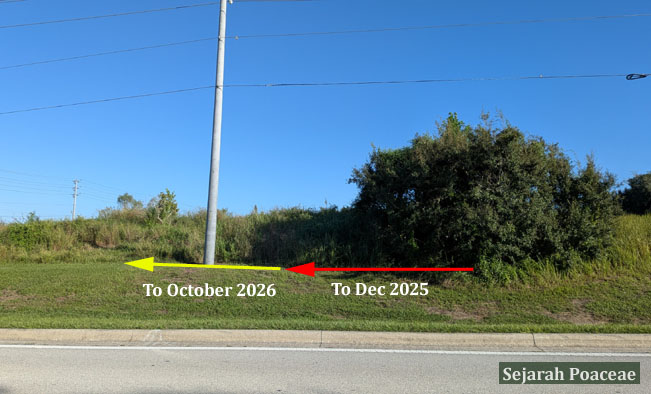
The farthest ramet was approximate 2.8 meters from the pole, which suggests a lateral expansion rate of 5.7 meters. This comes out to 0.57 meters/month, a rate which seems similar to the fastest rate of lateral expansion to one side that I had measured since the beginning. However, it needs to be said that the density of the cogon grass in the newly-invaded area is not extremely high. In fact, beyond the west pole, the ramets are only present in isolated patches.
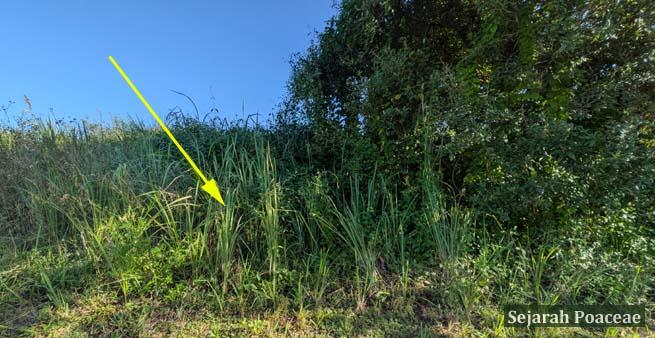
Nevertheless, it seem that the cogon grass has restarted its westward expansion along the road and its relatively rapid takeover of the flora that until recently had been protected by the shading of the large tree.
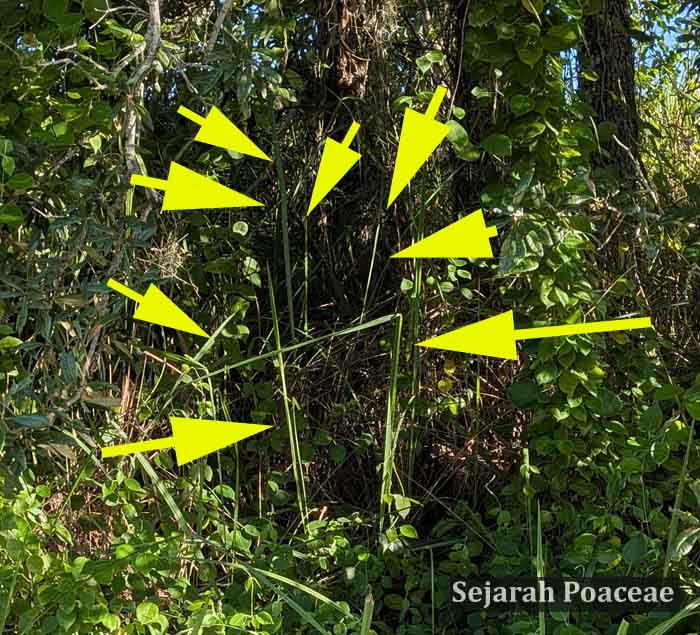
Speaking of which, I looked under the shaded canopy of the tree itself and noticed quite a number of cogon grass blades sticking out in seeming defiance of the dark interior. These most likely are being supported by other ramets with photosynthates via the ubiquitous rhizomes (or horizontal underground stems) that are generated so prolifically by the species.
I should note that the cogon grass is getting towards a road intersection. This means that in two or so years this series of annual observations will come to a close, although perhaps it might be interesting to see how it fares along the sides of the other intersecting road (given the change in light regime and perhaps other factors).
Leave a Reply