
When I became interested in banyan trees, I used to travel long distances to view individual specimens of these magnificent critters. By virtue of their lignified long-standing trunks and stems, it is possible for single tree specimens to last and be seen in one spot for multiple human generations.
Most grasses do not have this option, as their herbaceous above-ground structures are relatively transient (although their underground parts are the ones that can last decades and perhaps even more). But one possible exception are the bamboos, whose lignified culms can reach magnificent heights. Each individual culm may last only for a few years, but the bamboo cluster itself can last more than a hundred years, until some mass flowering event ends its tenure.
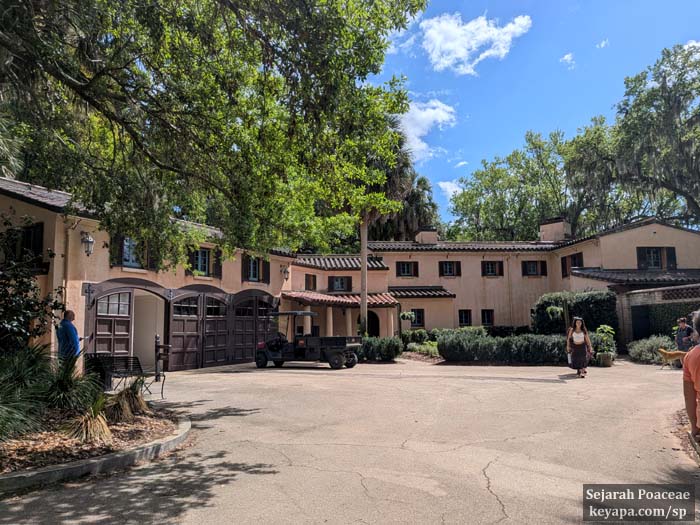
We visited Bok Tower Gardens in Lake Wales, FL last week, and since I am still in my bamboo fascination phase, the first thing I asked at the visitor center was whether they had bamboo groves. She mentioned visiting El Retiro (“The Retreat”), located at the other end of the gardens.
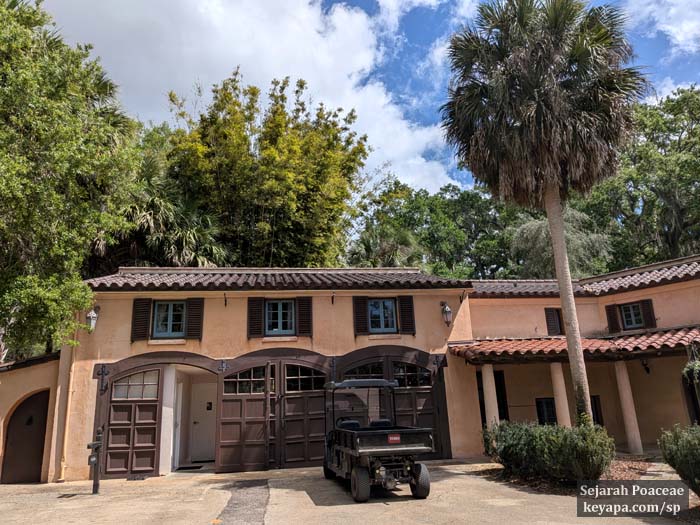
This 20-room Mediterranean-style mansion was built in the 1930s for Charles Austin Buck, a Bethlehem Steel executive. The surrounding gardens was designed by Frederick Law Olmstead Jr., a landscape architect and city planner who also worked in Acadia National Park, Yosemite National Park, the National Mall, and the White House grounds.
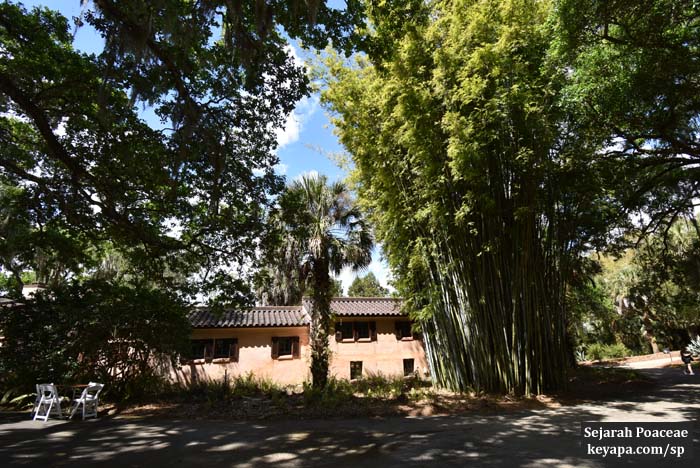
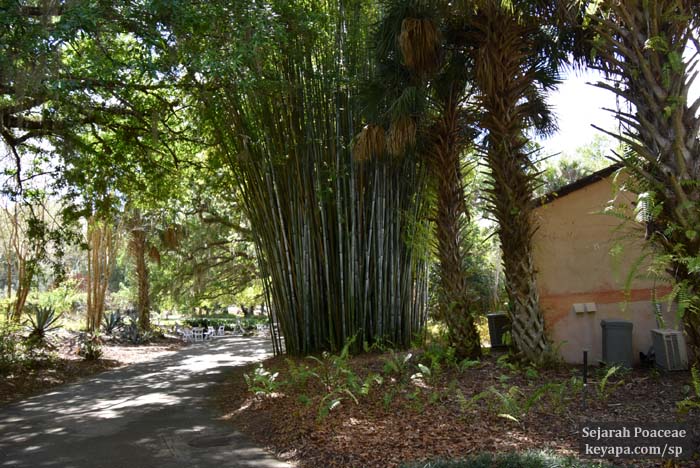
A visitor entering the gardens approaches this mansion from the back, but even the rear was impressive, and I could well understand why it was added to the National Register of Historic Places in 1985. Large oak trees and palms graced the grounds around it, but it was a single plant next to the mansion itself that inevitably drew the eye.
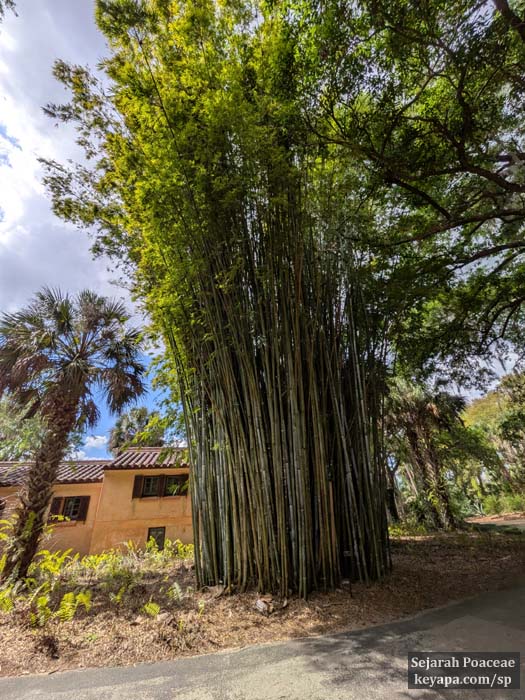
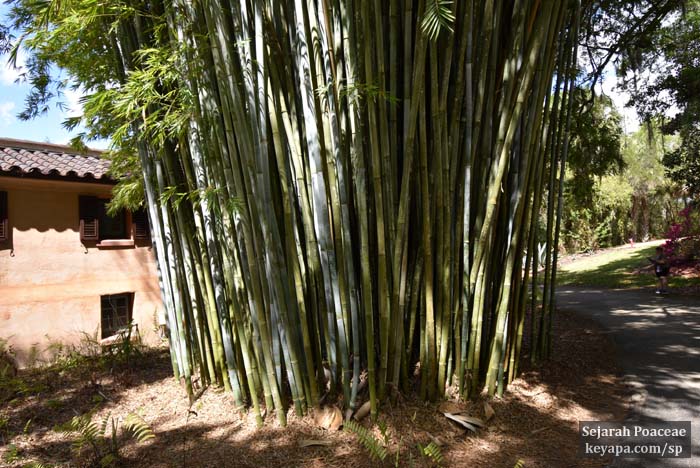
The bamboo was huge. It towered over the mansion and palm trees next to it, and was about the same height as the oaks in the same grounds. I estimated the diameter at the base to be almost 5 meters, and the height at around 20 meters. Unfortunately, I could not get accurate measurements, but I’ll be sure to remedy that the next time I visit the place.
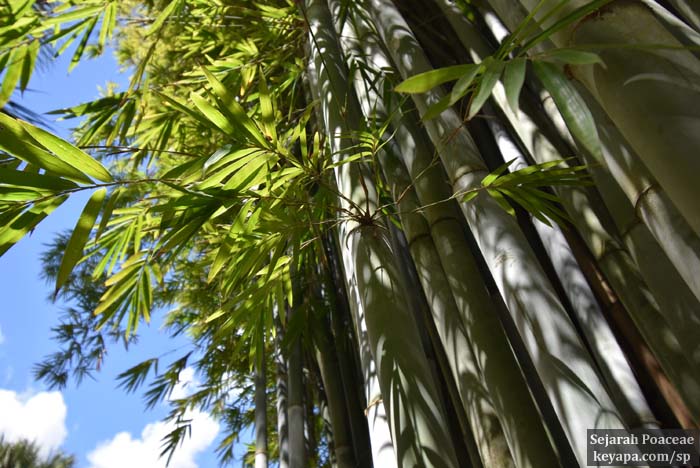
The culms had a beautiful bluish green sheen to them, although some of the the lower parts had been marred by graffiti scratched onto the surfaces by the usual idiots. It was an extraordinarily handsome specimen of the species Bambusa chungii, especially given that it enjoyed the recognition of being the only bamboo in the lot. I overheard a few people commenting on it, who otherwise ignored the other flora in the vicinity.
This particular specimen has been here since at least 2017, and it was noted in iNaturalist at the time. However, an autobiographical note from the mid-1950s indicates that the current bamboo cluster had not been there 70 years ago. Instead, the author mentions that:
There used to be a fairly big bamboo grove in this direction, which grew out of the bamboos planted by Edward Bok. But that grove was no longer there.
This seems to indicate that there have been various bamboo clusters planted near the home since it was constructed in the 1930s.
Unlike most other plants, many woody bamboos undergo mass synchronous flowering, followed by death. That is, bamboos in a population grow vegetatively and reproduce asexually for decades, then entire forests of bamboo flower over the course of a few years and die. The time to flowering (and seeding) can be extremely long. For example, Phyllostachys bambusoides may take up to 120 years between flowering. This flowering takes place across all the individual members of a genet, and can occur even if cut and regrown pieces have been taken somewhere completely far away.
Different species, and different populations within a species, can have varying flowering cycles. Members of the genus Bambusa seem to have flowering cycles that range from just 30 years in Bambusa bambos, to more than 150 years for Bambusa vulgaris (Zheng et al, 2020)! But most seem to flower and die before their centennial birthday. Thus, the fact that the current cluster has not been there since the mansion was constructed almost 100 years ago is not too surprising, given the way the bamboo life cycle works.
Nevertheless, this does not detract from the impressive stature and kingly aura of the current tenant of the lot. I’ll be sure to check up on it once in awhile, and if you are ever in the Central Florida area, perhaps you too should visit and pay homage to the current ruler of the El Retiro mansion, the majestic King Bok!
Literature Cited:
Zheng X, Lin S, Fu H, Wan Y, Ding Y. The Bamboo Flowering Cycle Sheds Light on Flowering Diversity. Front Plant Sci. 2020 Apr 17;11:381. doi: 10.3389/fpls.2020.00381. PMID: 32362903; PMCID: PMC7180196.
Leave a Reply