
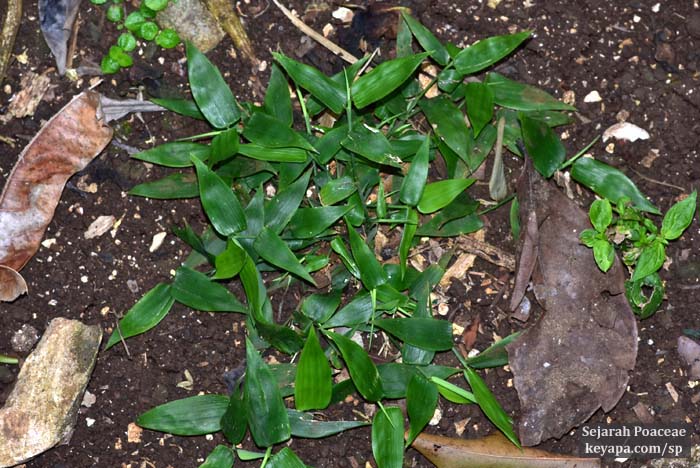
In a previous post I talked about botanizing for the herbaceous bamboo Lithachne pauciflora in Montego Bay, Jamaica.
This bamboo is quite small, and looks very much like any shade loving grass, with its wide leaves and short stature. Because of this, one of the readers asked how to identify the species and differentiate it from the latter, which I believe was a valid question.
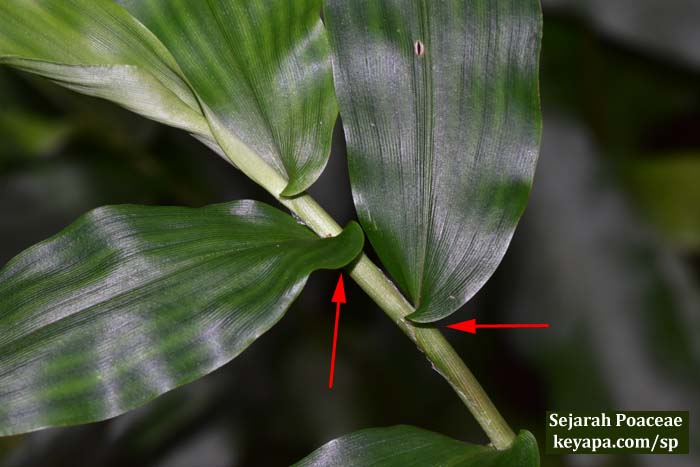
Personally, I think the easiest way to do this is to look at the attachment point of the leaves to the culm. In the shade loving non-bamboo grasses that I know, the leaves attach directly onto the stem itself.
In the image above are leaves of Lasiacis divaricata, a member of the Panicoideae subfamily, but a species that looks so much like bamboos that it is called “wildcane” locally. Notice how the base of the leaves wrap around the stem.
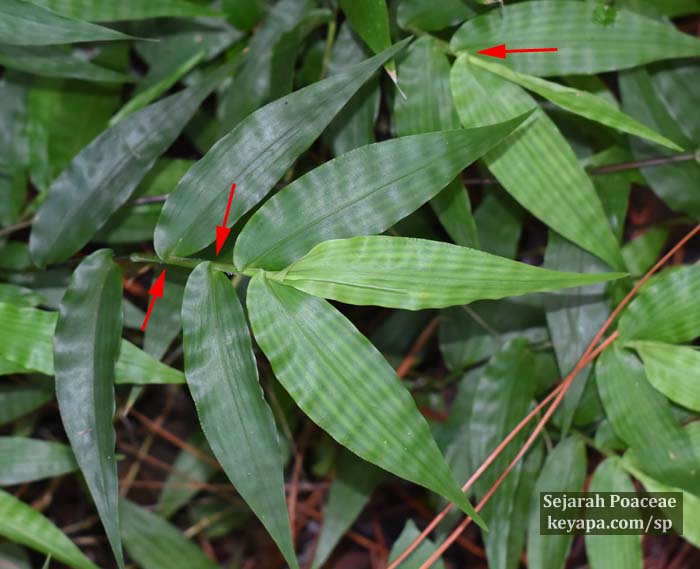
The same goes for the smaller Ichnanthus pallens above, whose leaf bases also tend to wrap around the stem. This species is also a member of the Panicoideae, and most definitely not a member of the Bambusoideae.
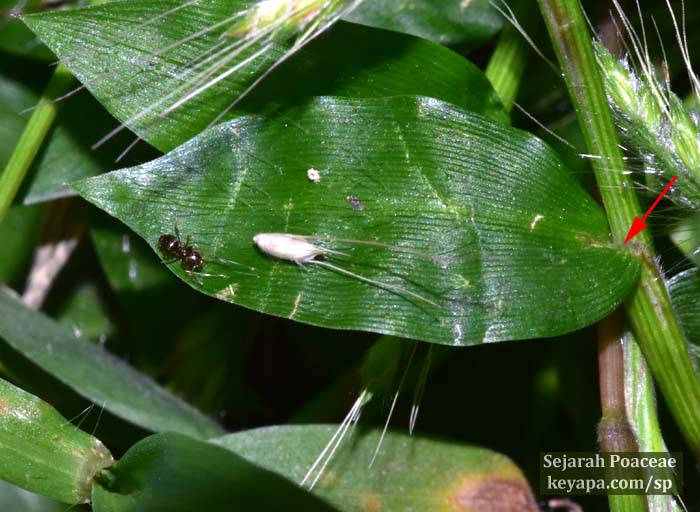
A third member of the Panicoideae is Oplismenus burmannii above, and although the base of the leaves do not try to wrap around the culm, it nevertheless remains flush against it.
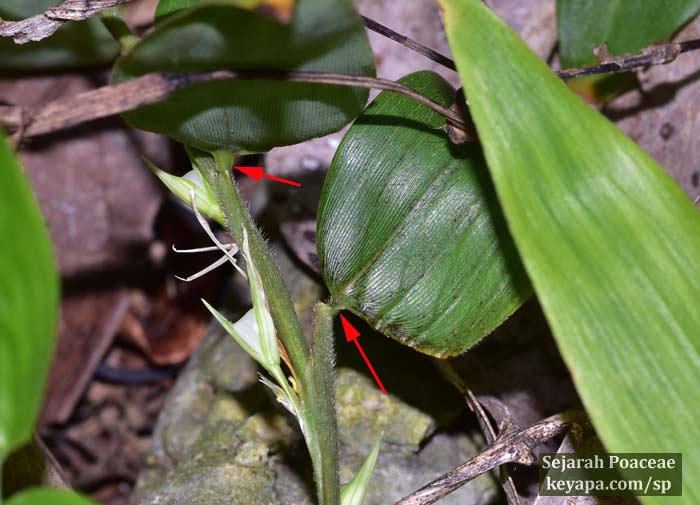
Finally, take a look at the herbaceous bamboo Lithachne pauciflora (commonly known as Diente de Perro) above. The base of the leaves clearly do not attach directly to the culm, but are instead connected via a short slender structure called a pseudopetiole.
Pseudopetioles are mostly unique to bamboos (within the grass family) and connect the leaf lamina to the leaf sheaths. They allow limited movement of the leaves, and they are distinct enough that their presence have been used to tag fossil plants as bamboos (Wang 2013).
So there you have it. The next time you see a shade-loving grass with wide leaves during a walk through a forest, take a quick look and see whether the leaves are connected via a pseudopetiole. If they are, congratulations! You have found a member of the really cool herbaceous bamboos.
Literature Cited
Li Wang, Frédéric M.B. Jacques, Tao Su, Yaowu Xing, Shitao Zhang, Zhekun Zhou (2013). The earliest fossil bamboos of China (middle Miocene, Yunnan) and their biogeographical importance, Review of Palaeobotany and Palynology, Volume 197, Pages 253-265, ISSN 0034-6667, https://doi.org/10.1016/j.revpalbo.2013.06.004.
Leave a Reply