
Botanizing during a cruise is always fraught with certain limitations.
Stops at locations generally are short, with most lasting only around 8 hours, and transportation is sometimes expensive or not available. Unfamiliarity with the location and allowances for personal safety also tend to be factors. In addition, you have to balance the needs of the other people on the trip with any personal desire to spend hours perusing what may be an area that holds little entertainment value to them.
Given these factors, I did not think it likely that I would be able to find a species of bamboo called Lithachne pauciflora (commonly known as Diente de Perro) that is native to the shady neotropics. It would be the first herbaceous bamboo that I have ever encountered, and was thus of great interest to me.

The great majority of bamboos that people notice or encounter are woody bamboos. These are divided into the monophyletic tribes Arundinarieae (temperate woody bamboos) and Bambuseae (tropical woody bamboos), and they have strongly lignified culms, specialized culm leaves, complex vegetative branching, outer ligules on the foliage leaves, bisexual flowers, and gregarious monocarpy (Wysocki et al, 2015).
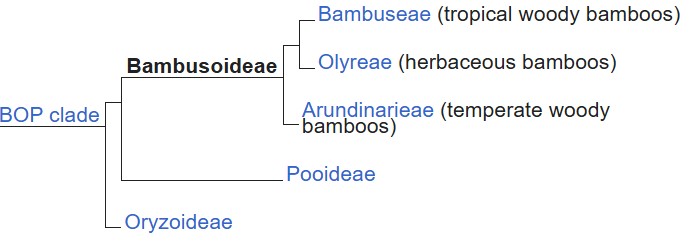
The herbaceous bamboos form the third monophyletic tribe in the Bambusoideae, the Olyreae (which is sister to the tropical woody bamboos). These bamboos are short, have a low degree of lignification and sport unbranched culms typically lacking culm sheaths, unisexual spikelets, and dimorphic florets (Qian et al, 2025).
Research seems to indicate that the herbaceous habit represents the ancient condition of the subfamily. From such humble beginnings the woody bamboos arose, although the exact progression is still clouded in doubt due to the complex reticulate evolution in the subfamily (Triplett et al, 2014).
I had never before encountered a herbaceous bamboo, and I was hoping that I could rectify that during an 8 hour stop in Montego Bay in Jamaica last week. I selected a location to search that was relatively nearby, publicly accessible, and one that would also entertain my wife while I botanized.

I was hoping to go by taxi to an artist gallery and garden called Ahhh…Ras Natango Gallery and Garden, but we were informed by some locals that it was closed for the day. However, my backup destination (Rocklands Bird Sanctuary at Montego Bay) was open, and we hired a taxi and proceeded to that location.
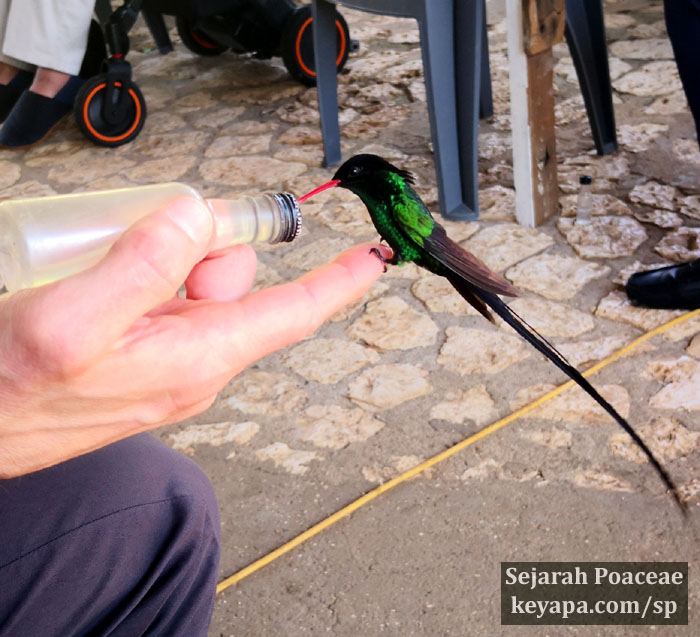
I should note that Jamaica was severely affected by the category 5 hurricane Melissa in October 2025, and many venues in the island still suffer from that disaster. The bird sanctuary was not an exception, and although we managed to feed some beautiful hummingbirds, I found out that many of the paths in the place were still closed off, blocked by fallen trees and undergrowth.
Nevertheless I endeavored to explore deeper into the sanctuary, and I carefully made my way along one main path, stepping over logs until I came to a point where masses of felled trees completely blocked the way forward.
But even with careful scanning of the path, I could not find any signs of the herbaceous bamboo species that I had come here to find. Instead, I found a rather large Paspalum species, as well as a cluster of Axonopus compressus scattered amongst a host of other plants.
After spending perhaps an hour and a half fruitlessly going back and forth along the path, my wife finally called out to me, and I realized we had to leave. Half-dejected, I trudged back towards the exit, only to make a short detour when we decided to visit the restrooms first before the trip back to the cruise ship.
The restroom was a detached tiny shed-building that was a dark green in color, and as we reached it I continued to scan the ground. Just before I got to the front of the shed I stopped and shades of a past botanizing surprise came over me. I had never seen Lithachne pauciflora before, but the leaves of a low ground plant suddenly garnered my full attention.
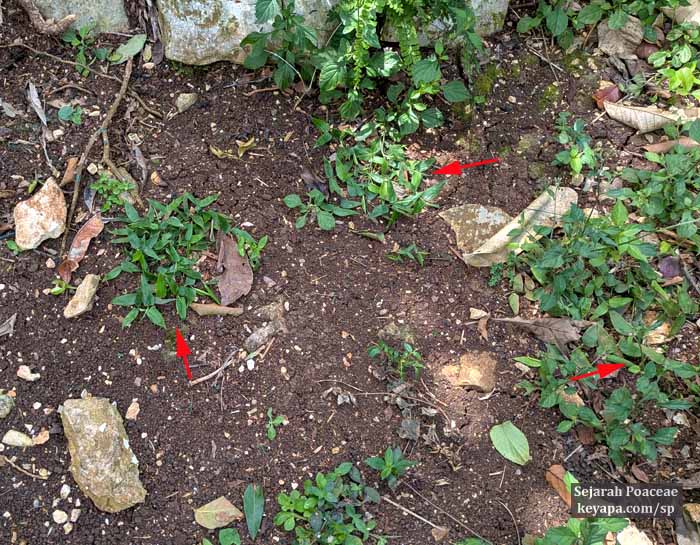
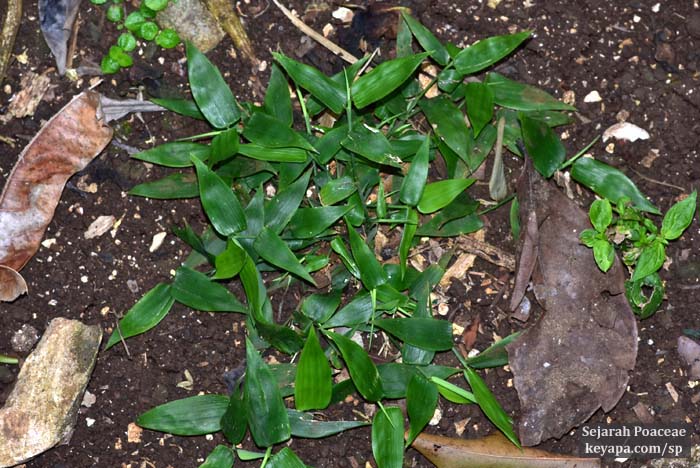
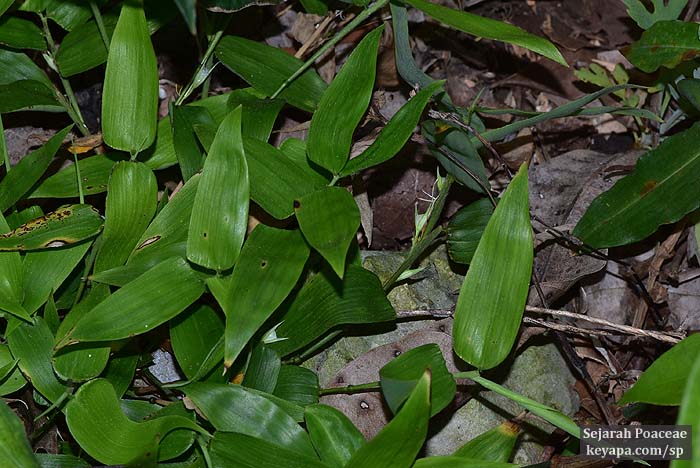
The plant had leaves with asymmetric bases, a distinguishing feature of the species that I was hunting. It had a compact habit, and it hugged the relatively bare ground, sprawling to a diameter of at most 20 to 30 cm. The attractive leaves themselves were only a cm in width and mostly 2 or 3 cm in length. I had found a specimen of Lithachne pauciflora!
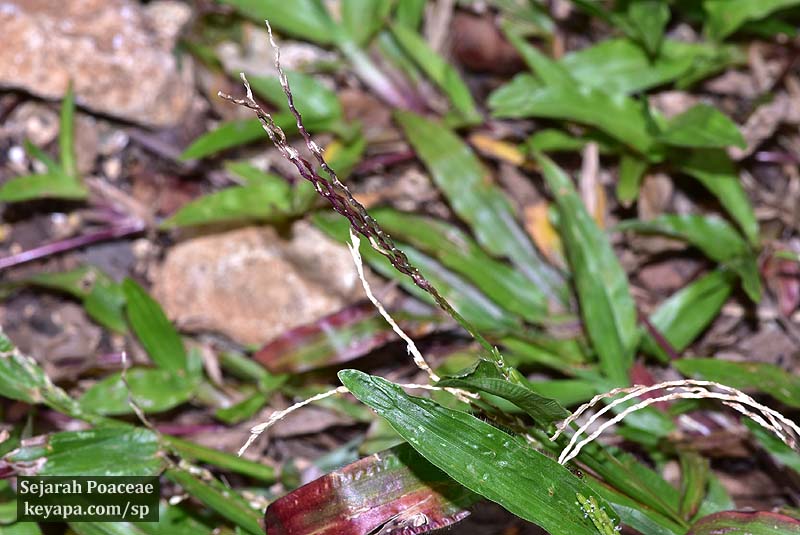
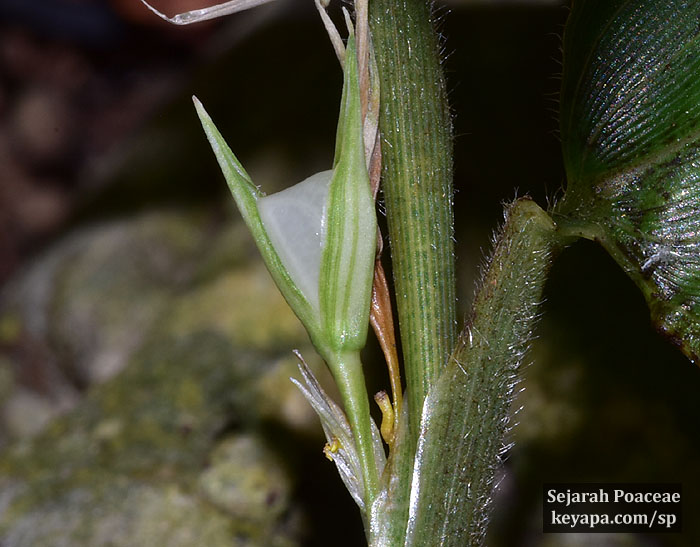
Interestingly enough, this species produces dimorphic florets, with separate staminate (male) and pistillate (female) spikelets on the same plant (so, it’s unisexual and monoecious). It also can have both terminal (with all male spikelets) and axillary inflorescences, although the specimens I found only had the latter. The axillary inflorescences I saw had distal pistillate spikelets, and what I thought seemed to be emerging staminate spikelets below the larger female spikelets.
Searching the nearby area, I found five more specimens of the species, all of them small and relatively innocuous. In every way, they looked nothing like the woody bamboos that people typically see. On first look, one would think they were simply one of the large-leaved shade-loving grasses that eked out a living in the dark forest undergrowth. But I could not be any happier. I had found my first herbaceous bamboo!
Literature Cited:
Qian, KC., Liu, JF., Yang, Y. et al. A high-quality chromosome-level genome assembly of herbaceous bamboo species Lithachne pauciflora. Sci Data 12, 1736 (2025). https://doi.org/10.1038/s41597-025-06024-2
Triplett, J.K., Clark, L.G., Fisher, A.E. and Wen, J. (2014), Independent allopolyploidization events preceded speciation in the temperate and tropical woody bamboos. New Phytol, 204: 66-73. https://doi.org/10.1111/nph.12988
Wysocki WP, Clark LG, Attigala L, Ruiz-Sanchez E, Duvall MR. Evolution of the bamboos (Bambusoideae; Poaceae): a full plastome phylogenomic analysis. BMC Evol Biol. 2015 Mar 18;15:50. doi: 10.1186/s12862-015-0321-5. PMID: 25887467; PMCID: PMC4389303.


Leave a Reply to admin Cancel reply