
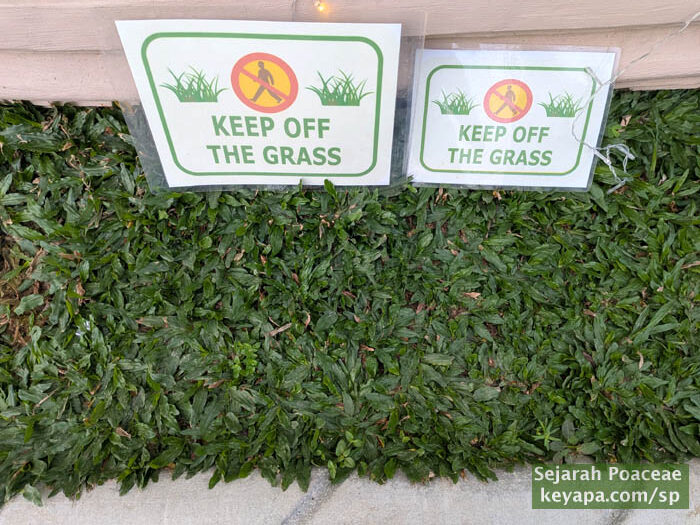
One of the interesting things I found out when visiting the Philippines was the heavy use of Axonopus compressus as turf grass. Although this stoloniferous species (it uses above ground shoots to spread laterally) is also used in the United States, and especially in Florida, I don’t believe I’ve actually ever encountered it there, where it goes by the common names “Southern Carpetgrass” or “Tropical Carpetgrass”. In the Philippines, it is known by the more notable name “Carabao grass”, in honor of the bovine that is used as a draft animal in small rice farms (as an aside, I am quite fond of carabao milk, which I pour on top of rice and sprinkle with rock salt).
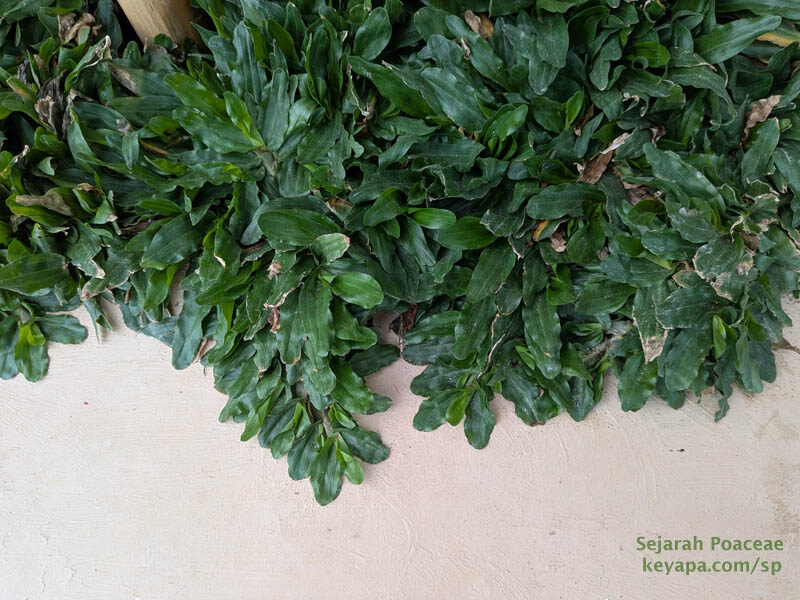
The first thing people might notice when they take a gander at this grass is the width of the leaves, which sets it apart from many other turf grasses, where a coarse appearance is sometimes considered a negative. This is because the species is widely considered to be very amenable to tropical shaded environments, and the wider leaves is perhaps adapted towards gathering more light.
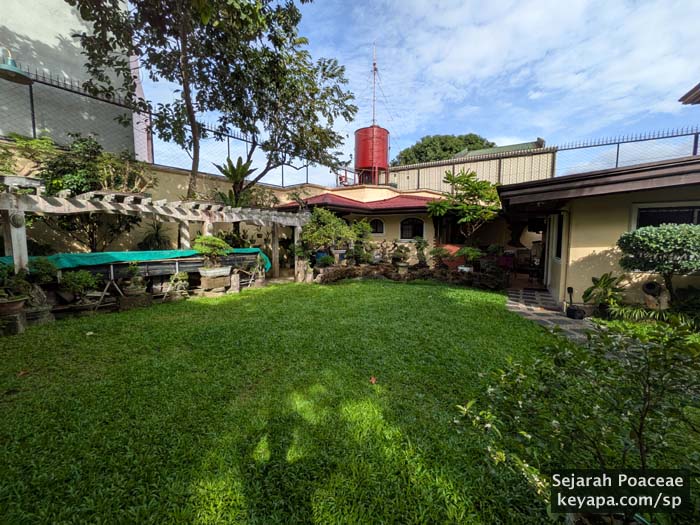
Due to the wider leaf blades and its overall physical appearance, this turf grass might not even look like a grass at all on close viewing (indeed, when I first saw it dotting an unkempt lawn, I thought that it was some kind of weedy forb!). But I have seen it used in relatively extensive grounds, and at least from afar, the lawns look quite similar to other lawns populated by the finer leaved grass species.
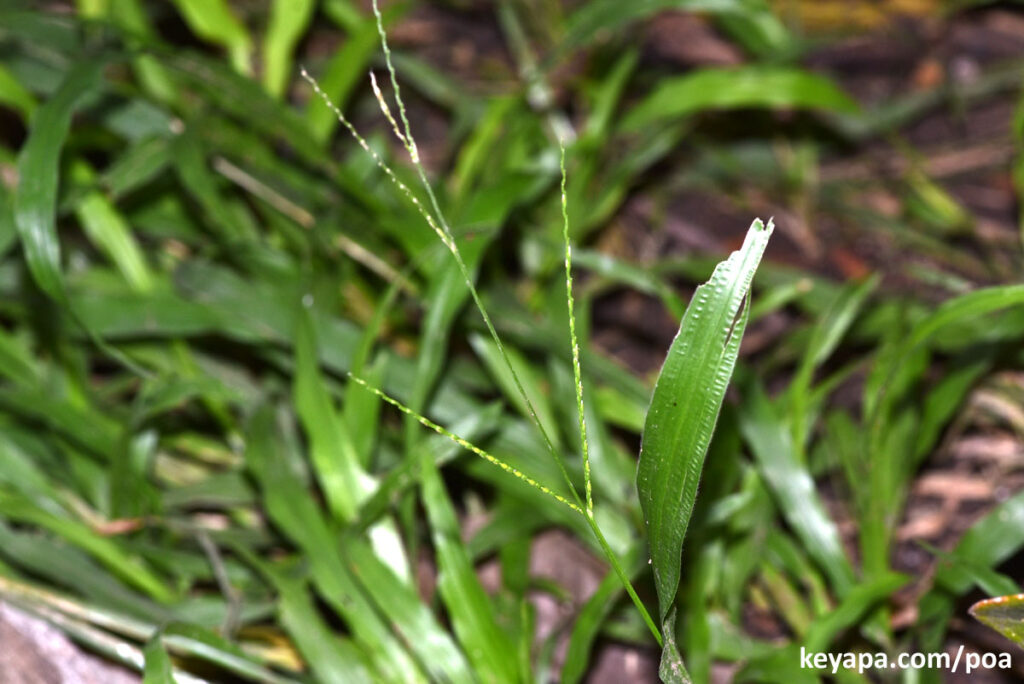
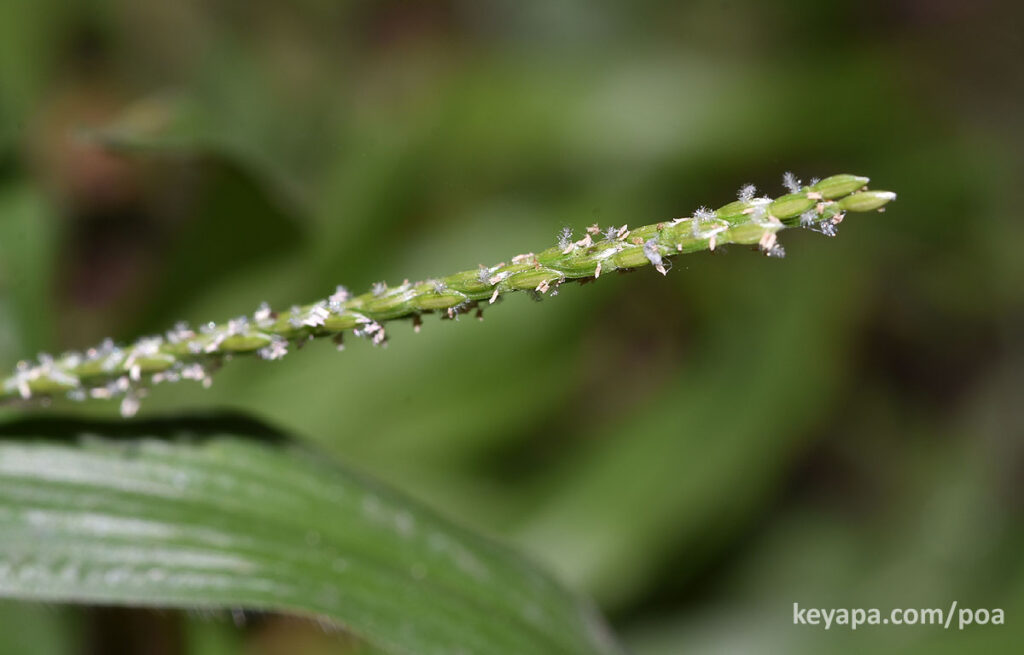
However, a close examination of the inflorescence of a flowering population would confirm its Poaceae heritage. The inflorescence are tiny and innocuous, the whitish stigma barely visible when superimposed on the relatively larger leaves.
The wider leaves, as mentioned above, is likely an adaptation towards darker light regimes, and this is borne out by studies which revealed that the yield of A. compressus increased in shade. In addition, its shoot to root ratio increased, as did its specific leaf area, both again adaptations towards low light condition (Samarakoon et al, 1990).
Beyond its use as a turfgrass, A. compressus is known for its ability to withstand many types of stress. For example, researchers found that severe drought stress activated a suite of genes responsible for drought tolerance in test plants ( Nawaz et al, 2021). This capability of the species extends towards other stresses, including the ability to tolerate toxic elements in the soil, which is why some researchers have explored the possibility of using A. compressus for phytoremediation. In this process, the grass will be used to restore and reclaim soils that have been heavily contaminated with either crude oil or toxic heavy metals such as lead, cadmium, and Zinc (Agarwalla, 2021).

So the next time you visit some tropical country, be sure to look closely at the lawns around you. You just might be lucky enough to meet the unusual, heavy metal eating, shade loving, tropical grass Axonopus compressus.
Literature Cited
Agarwalla, Sandeepa & Rajput, Dipika. (2021). Axonopus, a potential plant for phytoremediation: A review. International Journal of Ecology and Environmental Sciences. 3. 18-20.
Nawaz, M., Li, L., Azeem, F. et al. (2021). Insight of transcriptional regulators reveals the tolerance mechanism of carpet-grass (Axonopus compressus) against drought. BMC Plant Biol 21, 71 (2021). https://doi.org/10.1186/s12870-021-02844-7
Samarakoon SP, Wilson JR, Shelton HM. Growth, morphology and nutritive quality of shaded Stenotaphrum secundatum, Axonopus compressus and Pennisetum clandestinum (1990). The Journal of Agricultural Science. 114(2):161-169. doi:10.1017/S0021859600072154
Leave a Reply