

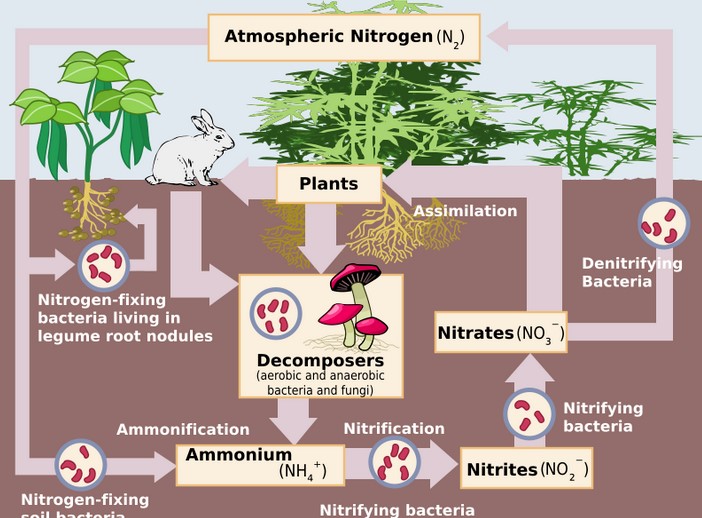
Nitrogen is an essential nutrient for plants. But while the element makes up 78% of the atmosphere as diNitrogen (N2), this form is unavailable to plants. The solution to this problem is nitrogen fixation, which involves the conversion of this atmospheric nitrogen into forms such as ammonia (NH3) that are available and useful to organisms. This biological conversion is also called diazotrophy, and is usually mediated by nitrogen-fixing basteria that have formed symbiotic relationships with the plants. The prime example of plants that form such symbiotic relationships with these bacteria are the legumes.
The presence of biological nitrogen fixation in the Poaceae has been somewhat murky in the past, although there is evidence it does happen with some varieties of Saccharum officinarum or sugarcane (Urquiaga et al, 2012). But a recent discovery in Mexico might have finally put to rest the notion that efficient diazotrophic associations between some grass species and endophytic bateria don’t exist.
In this case, researchers examined indigenous landraces of Zea mays (corn or maize) in the Sierra Mixe region of Oaxaca, Mexico. Such “landraces” are simply varieties of a domesticated species that have been developed over long time periods in a specific region. They focused on varieties that were grown in nitrogen-poor areas using traditional methods with little to no artificial fertilizers, hypothesizing that these might have evolved unique microbial communities.
What they found was astounding.
Aerial roots are roots that emerge from the above-ground nodes of grasses. The aerial roots of most modern corn varieties cease to grow after the plant transitions into adulthood, several weeks after planting. But in the Sierra Mixe maize that they discovered, the aerial roots continued to grow well into adulthood, and after awhile started to secrete a mucilage that was composed of a complex mixture of sugars (including arabinose, fucose, and galactose).
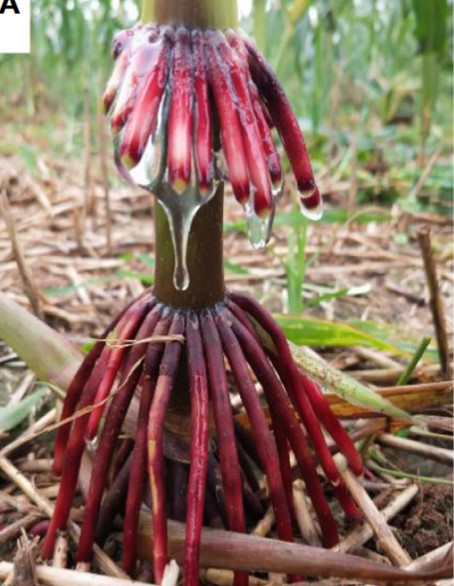
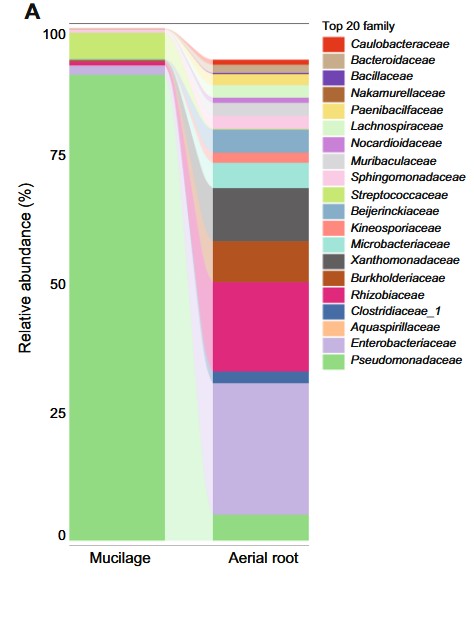
The aerial roots of the Sierra Mixe maize never touched the ground, and the scientists uncovered a rich community of diazotrophic microorganisms that they showed as having strong nitrogen-fixing capabilities. Finally, the researchers determined that the fixed nitrogen was efficiently transferred from the bacteria to the maize tissues, proving that what they had discovered was a landrace of nitrogen-fixing corn!
But the story does not end there.
Inspired by the discovery of the nitrogen-fixing corn, researchers in China tried to find the same trait in modern maize cultivars (Gao et al, 2023). They screened more than 250 inbred lines and found that most were able to produce some amount of aerial root mucilage, although in limited quantities, and only a rare few had any nitrogen-fixing activities at all. However, one line demonstrated very high nitrogen fixing enzyme activity and an abundant microbiota, and they isolated a gene that they called ZmSBT3 which seemed to modulate the production of the aerial root mucilage.
In order to verify the importance of this gene, they used the CRISPR/Cas9 gene editing technique to create variations of this inbred line where the gene was “knocked out” or inactivated. When later grown in nitrogen free indoor environments, these “knockout” plants showed significant increases in both nitrogen content and total biomass! This indicated that the gene is involved in regulating the production of the mucilage, which in turn determines the abundance of diazotrophic bacteria.
The discovery of biological nitrogen-fixation in maize/corn is not only of interest for biological reasons. Producing versions in highly productive modern cultivars will enable farmers to grow these crops without resorting to the use of artificial fertilizers in the future, a win-win situation for everyone!
Literature Cited
Gao, Jingyang & Feng, Peijiang & Zhang, Jingli & Dong, Chaopei & Wang, Zhao & Chen, Mingxiang & Yu, Zhongliang & Zhao, Bowen & Hou, Xin & Wang, Huijuan & Wu, Zhaokun & Jemim, Razia & Yu, Haidong & Sun, Doudou & Jing, Pei & Jiafa, Chen & Song, Weibin & Zhang, Xuecai & Zhou, Zijian & Wu, Jianyu. (2023). Enhancing maize’s nitrogen‐fixing potential through ZmSBT3, a gene suppressing mucilage secretion. Journal of Integrative Plant Biology. 65. 10.1111/jipb.13581.
Urquiaga S, Xavier RP, de Morais RF, Batista RB, Schultz N, Leite JM, et al. Evidence from field nitrogen balance and N-15 natural abundance data for the contribution of biological N-2 fixation to Brazilian sugarcane varieties. Plant and Soil. 2012;356(1–2):5–21.
Van Deynze A, Zamora P, Delaux P-M, Heitmann C, Jayaraman D, Rajasekar S, et al. (2018) Nitrogen fixation in a landrace of maize is supported by a mucilage-associated diazotrophic microbiota. PLoS Biol 16(8): e2006352. https://doi.org/10.1371/journal.pbio.2006352


Leave a Reply to Dana Cancel reply