
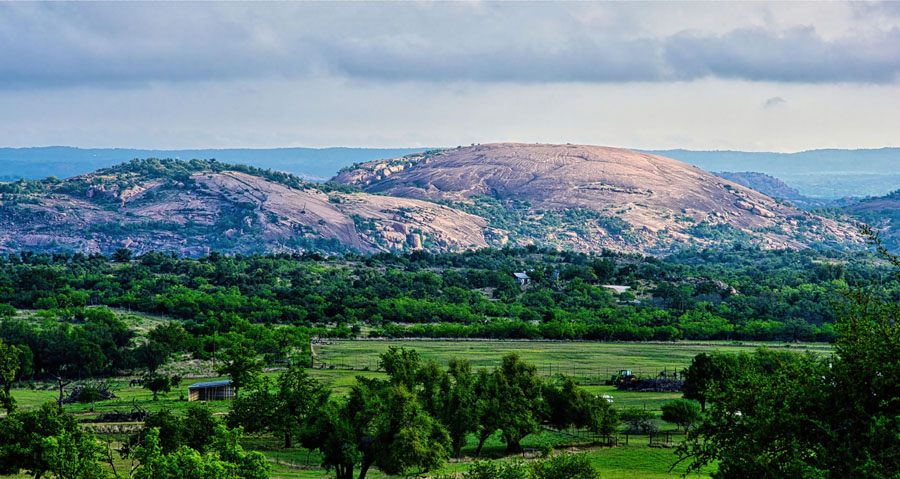
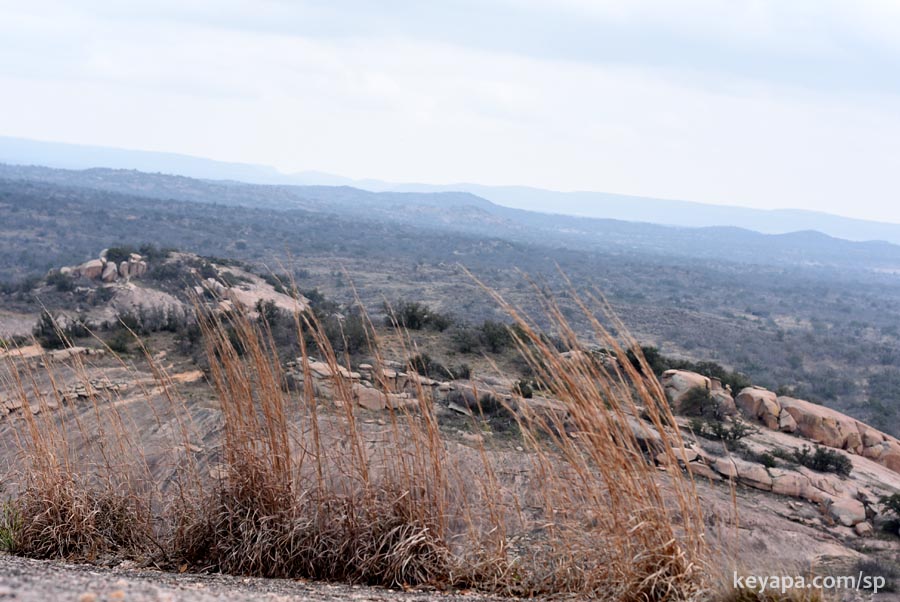
Near the center of the state of Texas, sitting amidst the rolling grass-covered hill country, a pink-colored granite dome erupts out of the earth and soars 130 meters up towards the sky.
This is Enchanted Rock, and it along with several other peaks next to it such as Little Dome and Turkey Peak, are called “batholiths”. These are large igneous rock formations made from magma that cooled and crystalized under the ground more than a billion years ago (that’s BILLION, with a B!), and pushed up the rock and soil above it. Over time, weathering of the top uncovered the pinkish granite.

The hard exposed granite surface at the top of Enchanted Rock creates an inhospitable terrain, with strong winds and drought making it very difficult for plant life to gain a permanent foothold on the surface. Transient vernal pools created by rainwater can and does hold animal and other life, including tiny translucent shrimp.
But the gradual erosion of the hard granite rock provides an opportunity for life to flourish, albeit under more stressful conditions than those experienced by plants down below. Moss and lichen can sustain themselves on the thin soil of newly-eroded granite, but it takes deeper soil to nourish larger plants.
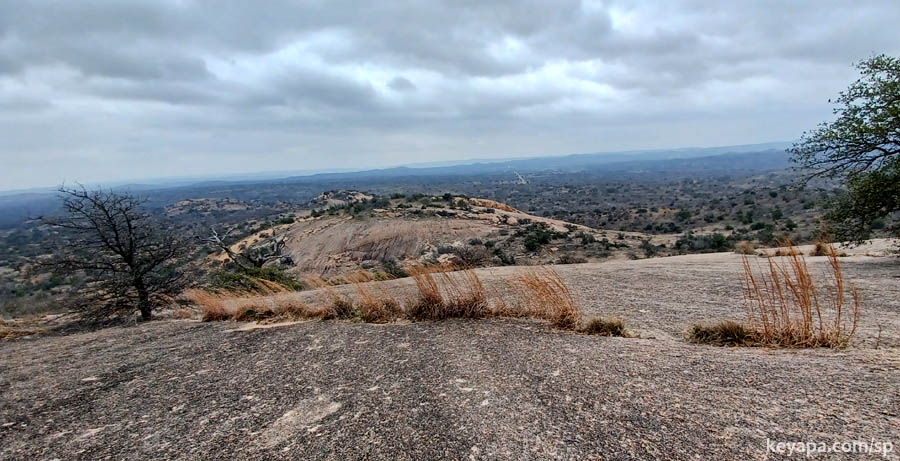
In such deeper and moist cracks and crevices formed from the erosion of the granite, the hardy Schizachyrium scoparium (subfamily Panicoideae, local common name Little Bluestem) carves out its niche atop Enchanted Rock.
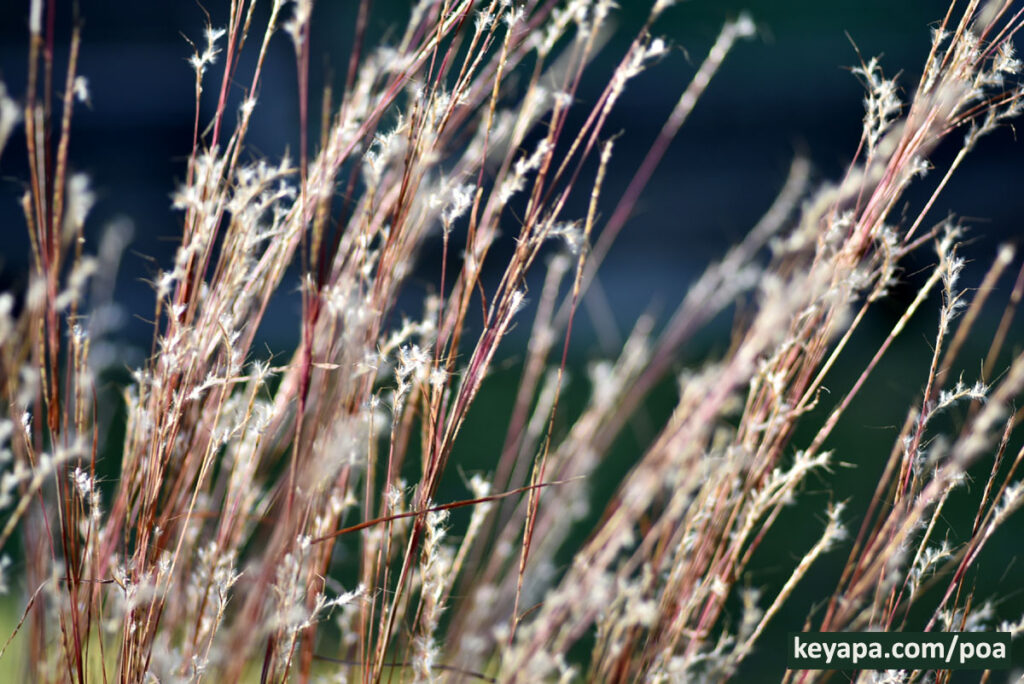
This beautiful widespread species is native and one that I have seen often in my travels, and it shares its environment at the top with various other higher plants. Prickly pear (Opuntia engelmannii) are in some abundance, and I also saw what i took to be low growing chollas (Cylindropuntia leptocaulis). There were even ferns growing in clumps under the shaded protection of overhanging ledges, and a few stunted oak trees (Quercus marilandica) lingered in soil that must be even deeper. In one interesting and special case, very low growing turf grass spread like an emerald mat across a wide (but perhaps thin) crust of soil.
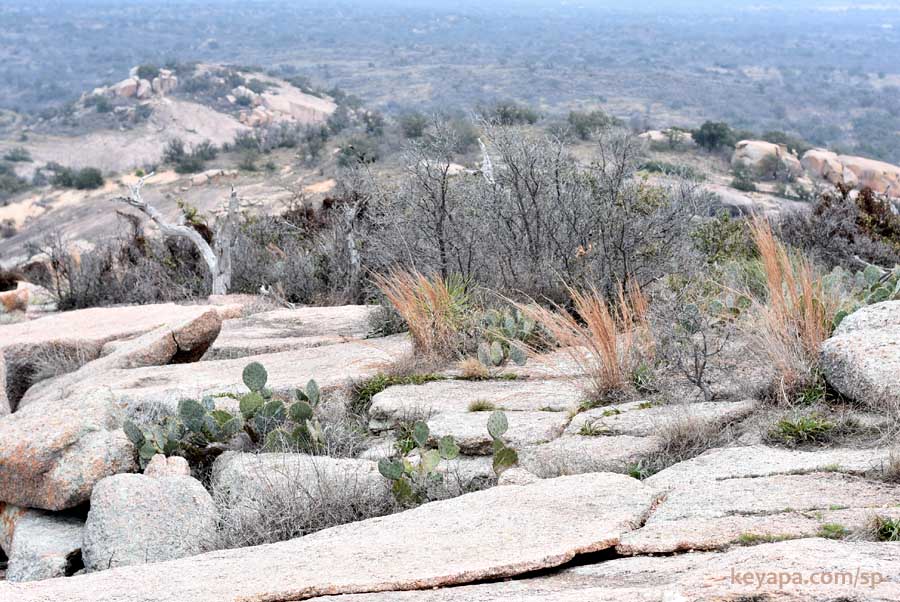
The establishment of populations of native grasses such as S. scoparium atop Enchanted Rock is contingent on rapid seed germination and rapid seedling development, as well as adequate moisture during its growth. The species is also a C4 grass, which facilitates its adaptation to lack of water. C4 grasses can tolerate adverse abiotic conditions that can result in carbon loss through photo respiration (such as high temperatures, high light intensities, and low water availability) because of its carbon concentrating photosynthetic process and ability to use water efficiently (Edwards et al, 2004). In fact, some studies have shown that S. scoparium can maintain higher photosynthetic activity than even other C4 plants during droughts (Dekirmenjian et al, 2024).
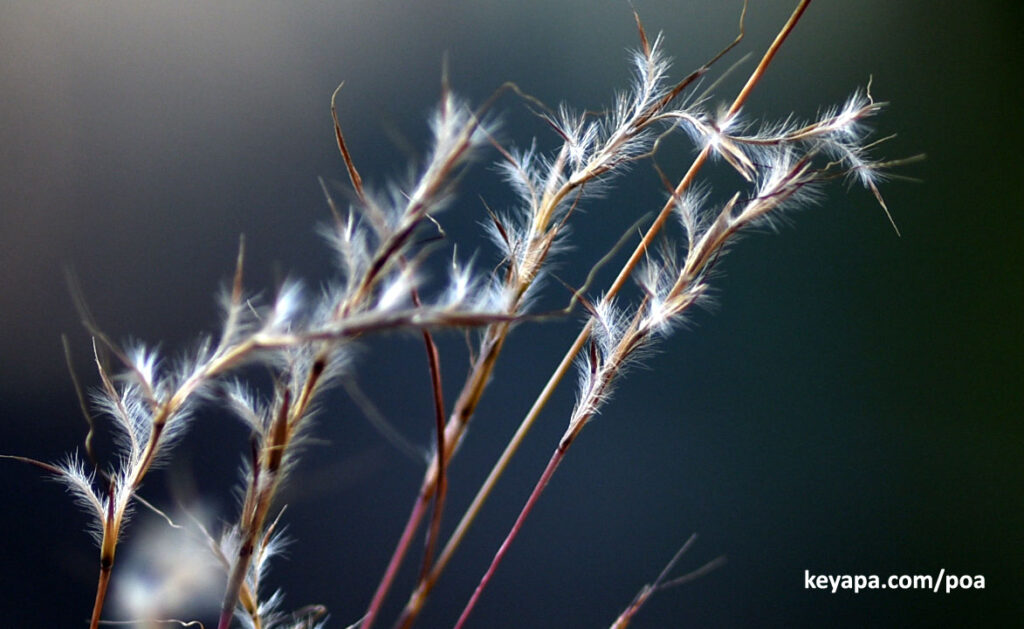
The ability of plants like S. scoparium to make a living in this inhospitable terrain amazes me, and the sight of their forms rising above the hard surface of Enchanted Rock elevates the barren batholithic landscape into a more complex biosphere, one that is dynamic and alive and evolving.
Literature Cited
Dekirmenjian A, Montano D, Budny ML, Lemoine NP. Schizachyrium scoparium (C4) better tolerates drought than Andropogon gerardii (C4) via constant CO2 supply for photosynthesis during water stress. AoB Plants. (2024) Mar 8;16(2):plae012. doi: 10.1093/aobpla/plae012. PMID: 38497050; PMCID: PMC10944017.
Edwards GE, Franceschi VR, Voznesenkaya EV (2004). Single cell C4 photosynthesis versus the dual-cell (Kranz) paradigm, Annual Review of Plant Biology, vol. 55 (pg. 173-196)
Leave a Reply