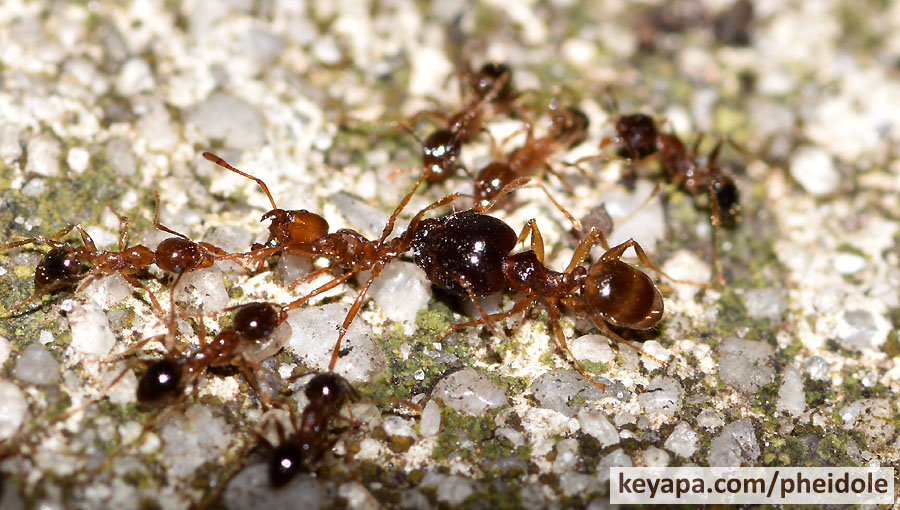
Note: apologies for the images. The location was poorly lit, and the ground was wet and and dark – overall a bad time to be taking pics, and especially of tiny ants.
I have been busy mapping the boundaries of a small Pheidole megacephala cluster by baiting workers out of peripheral nodes of the “super-colony” using cookie bits.
In one node that was located at the base of a tree along a walkway, I returned after 30 minutes one early morning to find that a frenetic battle was taking place close to the nest hole of the P. megacephala.

The attraction of Pheidole megacephala to cookie baits varies, and there are times when the bait is left alone for long periods of time, and so a scout from a Solenopsis invicta fire ant colony probably happened upon a bit of cookie, and had recruited a line of other fire ants to the bait.
Normally, faced with an onrushing column of S. invicta fire ants, many other ant species would probably withdraw, but in this case the Pheidole ants engaged the intruders. Although the node was at the very periphery of the P. megacephala cluster and thus likely underpopulated, I could see that there were perhaps 20 or so major workers rushing around helping to dispatch the intruders.
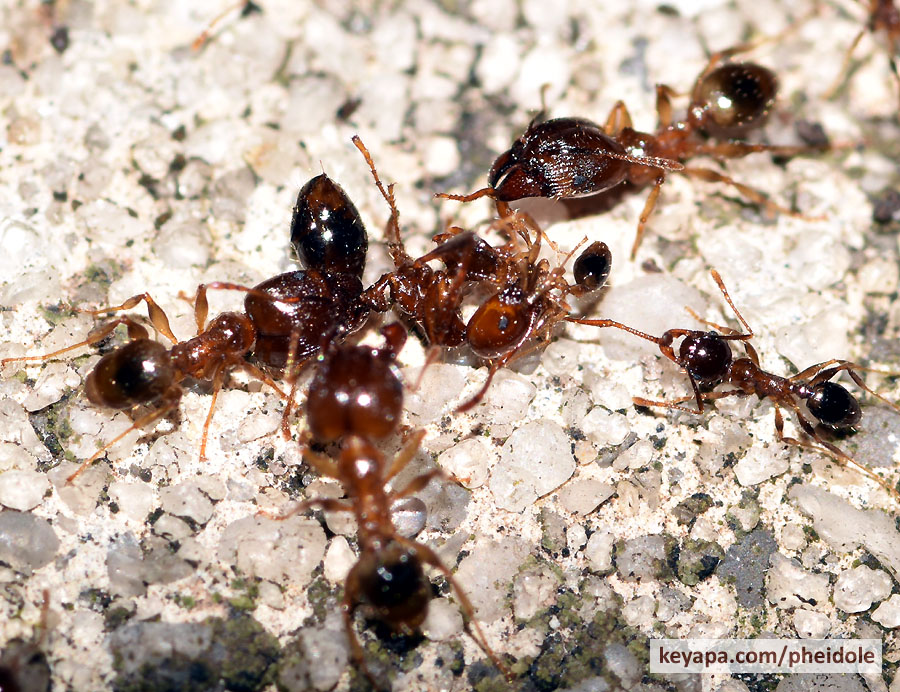
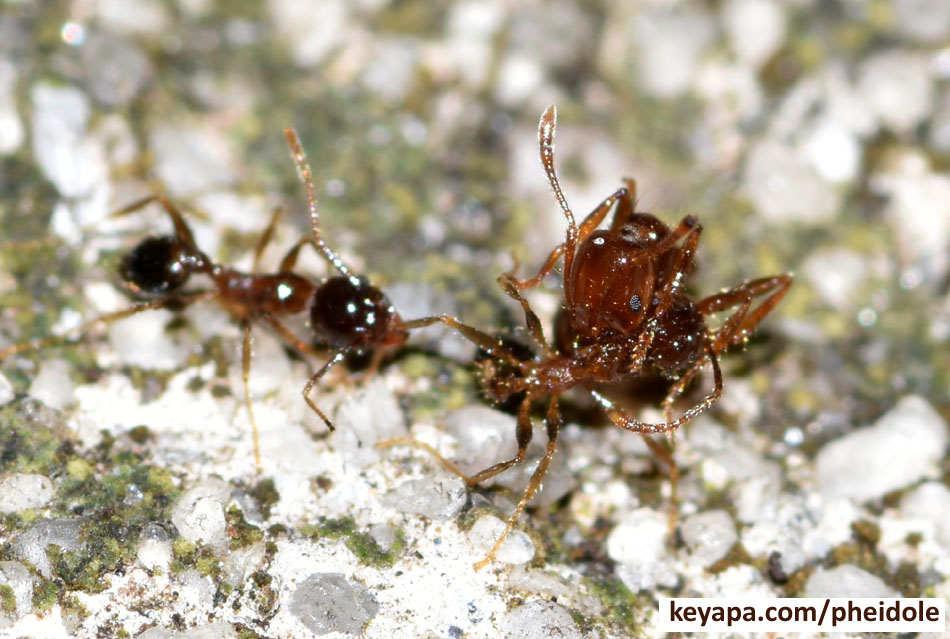
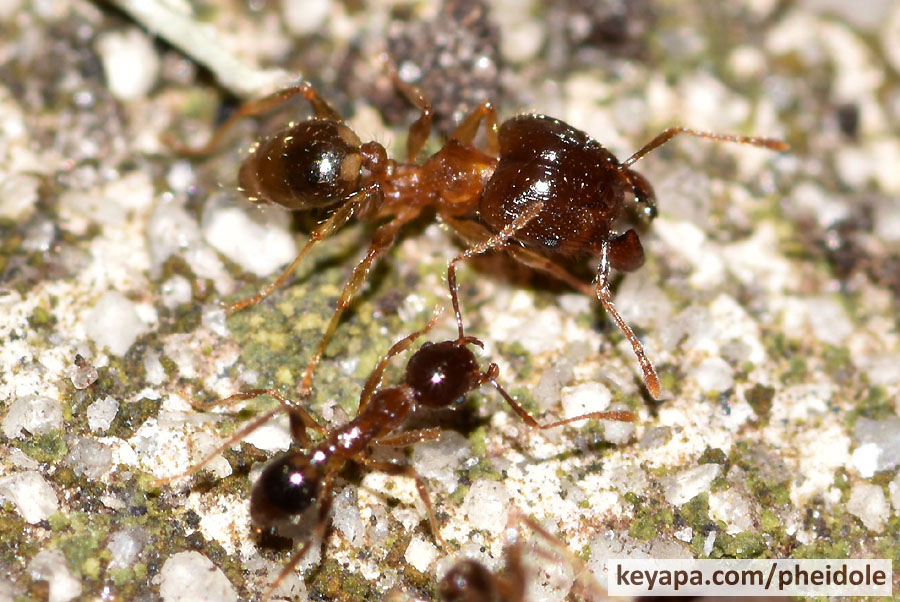
There were fire ants immobilized throughout the bait location, their stretched bodies ringed by Pheidole minor and major workers. There were also ants engaged in single combat. In one case, a fire ant tried to sting a Pheidole megacephala soldier, which had pulled it up and was trying to cut its opponent in two.

The Pheidole majors seemed to be quite adept at cutting the fire ants into pieces. Fire ant limbs, abdomens and limbless torsos were in evidence, and in one case one fire ant had its head severed.
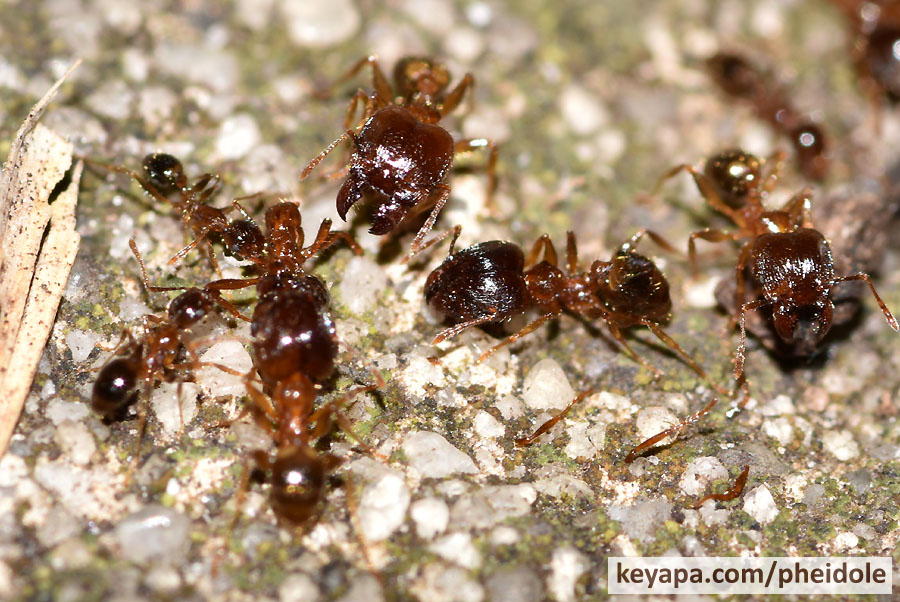
In many cases, the intruders were first stretched out by minor workers and rendered helpless. This technique is fairly standard in ants, and I’ve seen it put to good use by various species, including Oecophylla smaragdina.

A soldier sooner or later would wander by and quickly dispatch the luckless fire ant, using its mandibles to bisect the intruder.
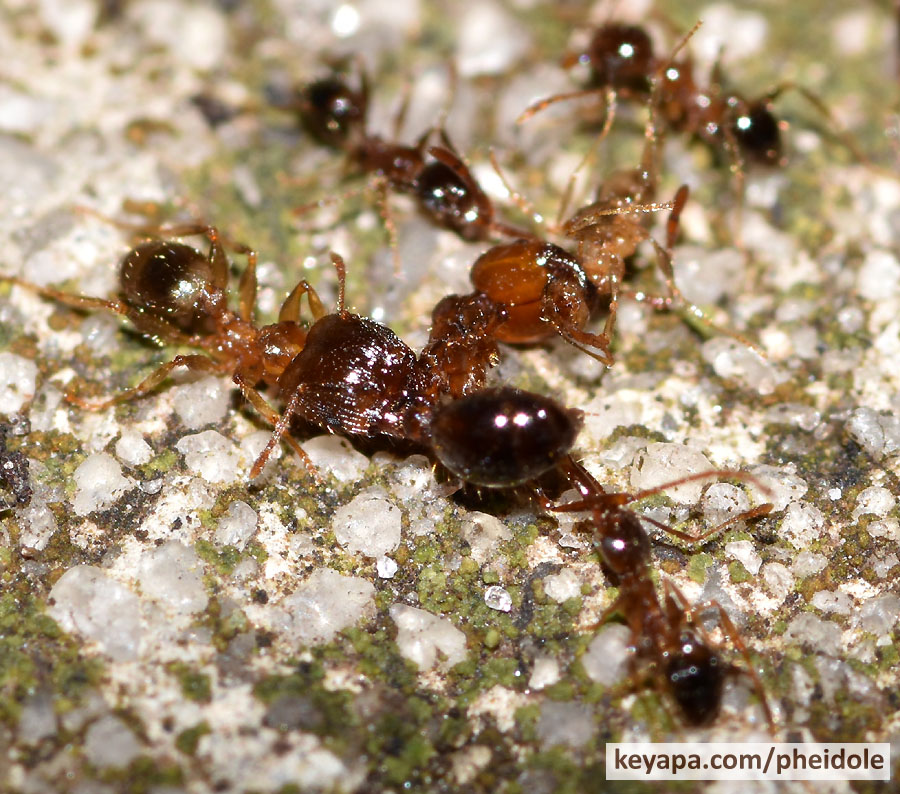
Fire ants who have thus been treated usually have severed limbs and abdomens.

Finally, dead fire ants were dragged and taken into the nest by the Pheidole, and so I assume they were being treated as prey.
During the fracas, major workers ventured far from the bait location, as if in search of any other intruders, so after awhile a cone of looping Pheidole cleared the immediate location of fire ants.
By the time I left, the location was bathe in sunlight and the Pheidole had withdrawn closer to their nest. The species is prone to desiccation and are usually not in evidence in exposed areas during the heat of the day.

I probably should point out that this is the first time EVER that I have seen P. megacephala engage another species in combat. Most times, competitors (other than maybe some of the usual opportunistic species like Brachymyrmex spp and Paratrechina longicornis) are absent from core areas that they control. In Key West, for example, P. megacephala was in a cluster with an area of around 90 ha, and I did not find a single fire ant colony inside that during a 2 day daytime survey of the area, but fire ants were very abundant outside the limits of control (Sunjian, 2018).
Literature Cited:
Sunjian, A (2018). A survey of ants in Old Town Key West in Florida and a review of Pheidole megacephala as an archetypal “hegemonic” species. The Pm Compendium (PMC). https://pheidolemegacephala.blogspot.com/2018/06/a-survey-of-ants-in-old-town-key-west.html
Leave a Reply