
I first saw these ants during one of my daily walks in our community here in Central Florida.
I was pleasantly surprised by the find, mainly because most of the ants I had been seeing were the usual Solenopsis invicta, interspersed with the larger Camponotus that were always in danger of being stepped on as they scurried along the pavement.
I was of course intimately acquainted with Pheidole megacephala because of my studies on that invasive species, and these ants were about the same size, if not larger, and thus they immediately attracted my attention.

At the beginning, I didn’t know or care what species it was, but just recently I decided to identify the ant, and it turns out it’s Pheidole obscurithorax, which is the largest Pheidole ant in Florida. Major workers have head widths of more than 1.5 mm, and total body lengths of over 6 mm.
The species is an invasive, although not as bad as Solenopsis invicta, which coincidentally also came from the same original location as P. obscurithorax. Both species are native to the flood plains and open pastures along the Parana River in South America. Like S. invicta, P. obscurithorax is a disturbance specialist, and it competes effectively against the former in both its native region and in areas where they are both exotic.
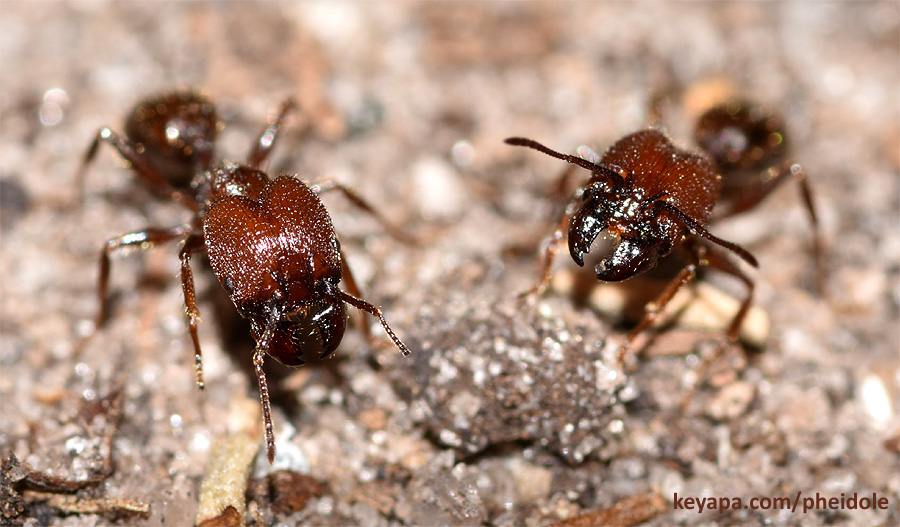
P. obscurithorax was first discovered in Mobile, AL in the 1950s, and from there it slowly expanded outwards at a rate that was much slower than the fire ants. It was only recently that their spread seems to have accelerated. By the 1990s, it had reached Tallahassee, FL (King and Tschinkel, 2007), and by 2015 specimens were being found in Central Florida . Interestingly enough, the current latitudinal range of the species in North America seems similar to its latitudinal range in South America (Wetterer et al, 2015).
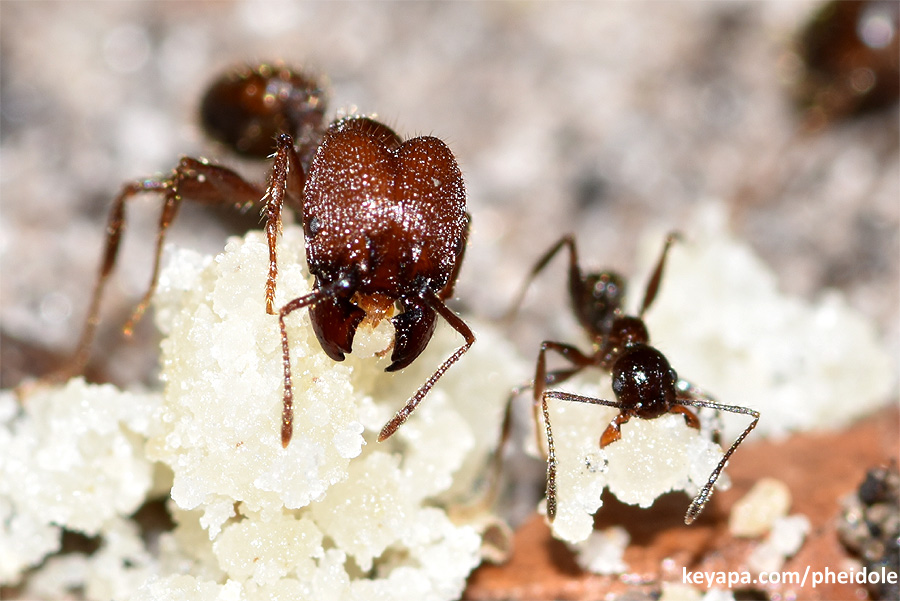
I have found several colonies of this species in the week that I’ve looked for them. Nest entrances were very inconspicuous at times, although in several locations there are distinct nest mounds.
The minor workers move fast, and because of their black coloration, I have mistaken them for Paratechina longicornis. The major workers are not top heavy and can move quickly as well. They participate actively in going to baits, and help at times with bringing large pieces of cookie bits back to the next entrance. Unlike P. megacephala majors, these majors seem a bit more skittish, and do have a tendency to run back into the nest when disturbed by me.
The ability of this species to recruit to food is surprisingly good. I have seen minors and majors flood out of the nest and head quickly towards a bait several meters away after being alerted by an incoming scout. This mass recruitment probably is one reason why they can co-exist with S. invicta and are the number one competitor of that species in many locations. I discovered the dead bodies of Solenopsis invicta near one nest mound, and there are reports that they may scavenge (or prey?) on the fire ants.
So far, I have seen it foraging during the latter hours of the afternoon, and did not find it out in force during dawn, when the temperatures here are still less than 70 F (21 C).
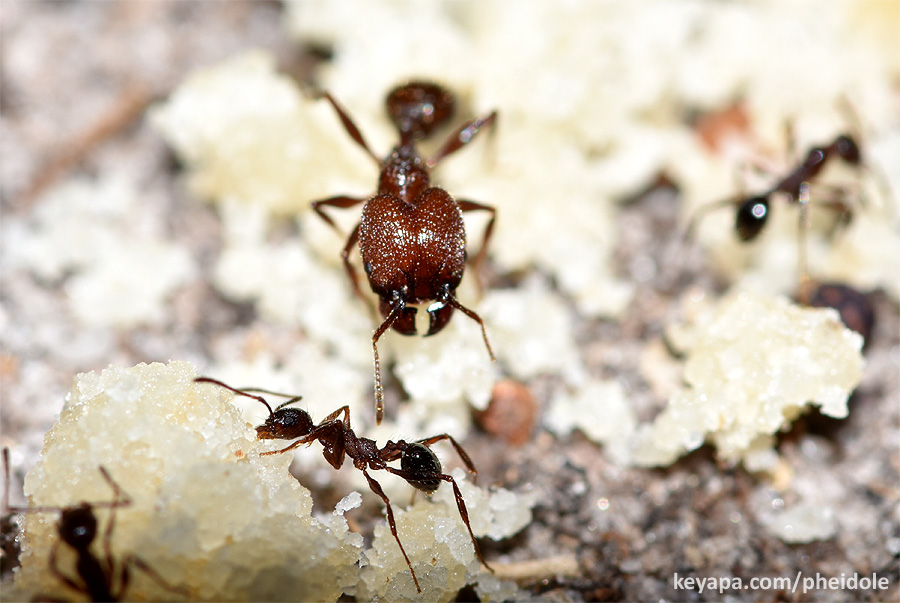
Another interesting thing that I noticed is that I have found nests of this species surprisingly close to nests of another Pheidole ant, which I have tentatively identified as Pheidole dentigula. In one case, the nest entrance of P. obscurithorax was perhaps only 2 meters away from a colony of P. dentigula. I do not know whether this was a coincidence due to the fact both seem to be found more easily in areas with no fire ants, or whether there is some other factor at work. Either way, I look forward to learning more about this fascinating species.
Literature Cited
King, Joshua R., and Walter R. Tschinkel. (2007) “Range expansion and local population increase of the exotic ant, Pheidole obscurithorax, in the southeastern United States (Hymenoptera: Formicidae).” Florida Entomologist 90.3: 435-439.
Wetterer, J. K., Macgown, J. A., & Calcaterra, L. A. (2015). Geographic spread of Pheidole obscurithorax (hymenoptera: Formicidae). Transactions of the American Entomological Society, 141(1), 222-231.
Leave a Reply