
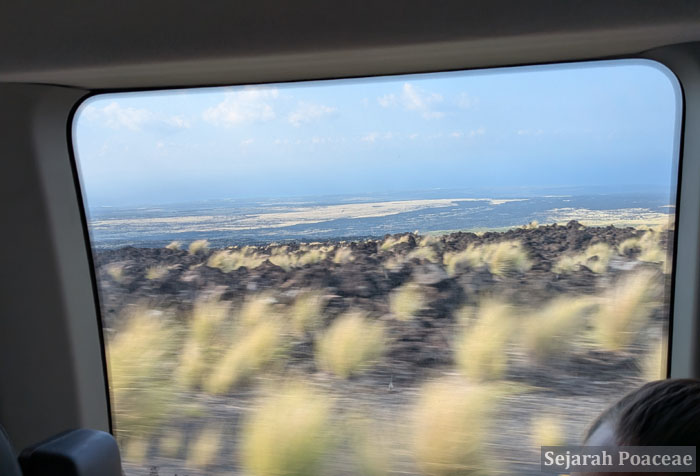
We are currently on a trip to Hawaii, and I have had to indulge in what is likely the worst way to survey the flora during excursions organized by the cruise ship and our own fast trips in the islands. This type of activity is called highway botanizing, which is also known as roadside botanizing or 100 kph/65 mph botanizing.
The factors involved in successfully identifying plants when rocketing past at high speeds are fairly simple but crucial.
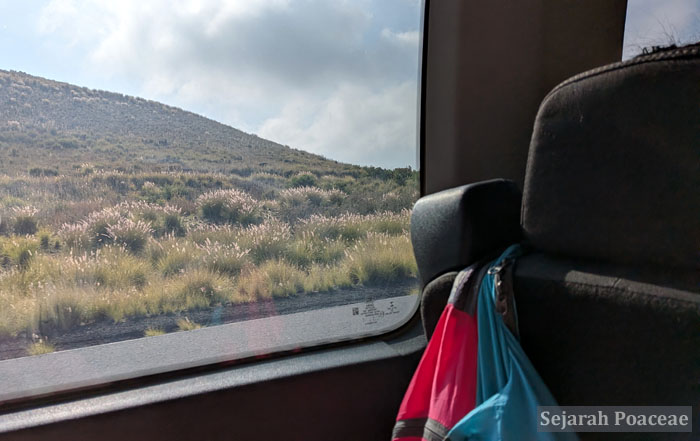
One factor that is important is that the organisms to be identified must be at least meter-scale when it comes to size. It is very hard to figure out the species when they are much less than a meter in size (unless said species fulfills some of the other factors below). This means that only certain types of grass species can be reliably identified at a distance and at speed. For example, during this trip, the very large aggressive invasives Megathyrsus maximus and Cenchrus purpureus were distinct enough that I was able to ID them as we passed by.
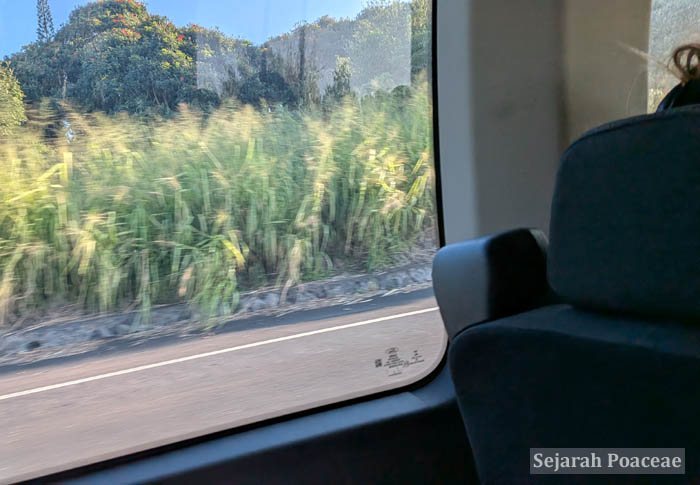
Another factor that could influence identification is that the organism has to have some distinguishing feature that stands out in the monotonous green of the vegetation. For example, its inflorescence could be a vibrant color, or it might have a shape or outline that is distinguishable from a distance. The species Melinis repens with its massed red flowerheads in Florida is an example of such a species, although during the trip to Hawaii I was thwarted by a critter that I had not encountered before, the equally invasive Melinis minutiflora! What I thought were masses of M. repens on the roadside turned out to be this latter species when I finally had a chance to examine them closely.
The overall habit of the species can also be a big factor. The way it grows or looks as a whole might be enough to narrow down the possibilities and enable identification. For example, Imperata cylindrica in Florida has a body plan and an overall group habit that makes it fairly easy to distinguish even at highway speeds.
But perhaps the most important factor is the observer’s familiarity with the organism. One has to be rather intimate with the habits and form of the species in order to reliably ID it. And even then one can be mistaken when encountering similar species for the very first time, as had happened to me with M. repens and M. minutiflora.
It takes experience and a good eyesight to do highway botanizing, and in the end, I would rather see and examine these critters closely while walking on my own two feet.
Leave a Reply