
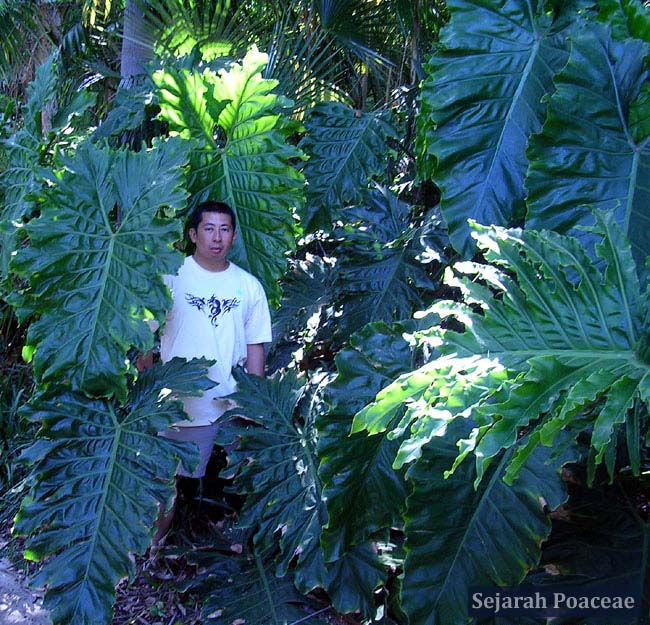
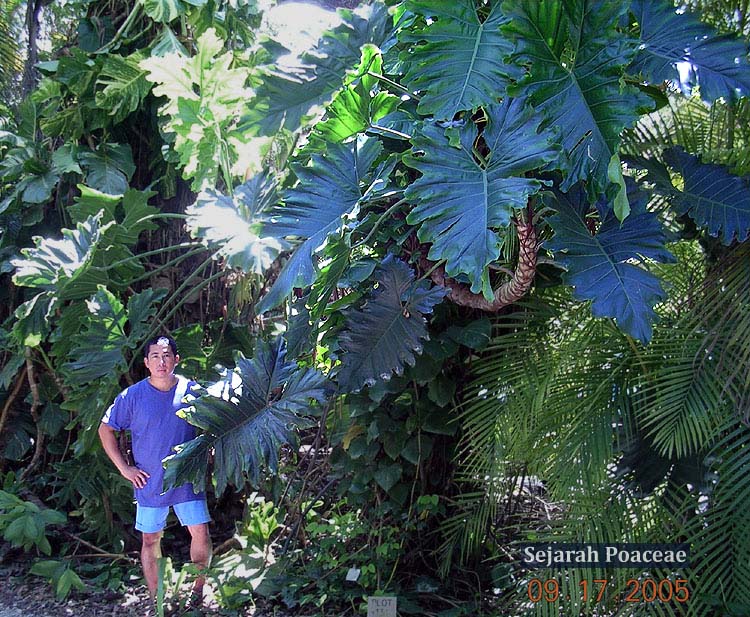
Plants of the genus Thaumatophyllum are spectacular arborescent aroids that were formerly grouped in Philodendron subgenus Meconostigma (family Araceae).
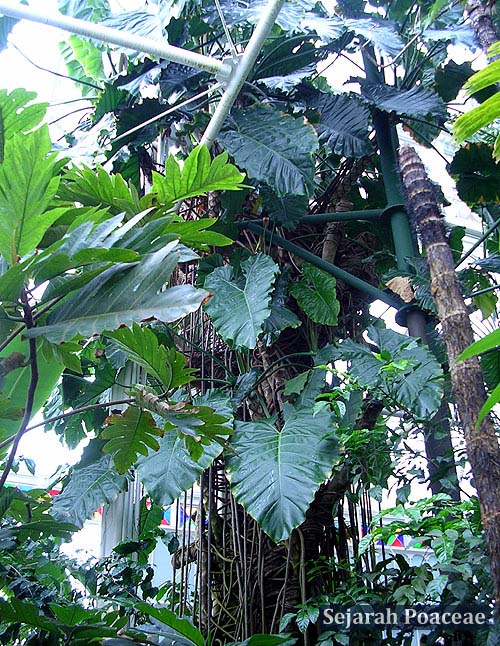
They are secondary hemi-epiphytic plants that have become mainstays in the horticultural world because of their ability to either stand tall on their own lignified trunks, or scramble up the tallest trees in search of light in the canopy by using their strong aerial roots for purchase.
I’ve been an Aroider since the mid-1990s, and these aroids became my favorite group when I read a coffee table book called “The High Frontier: Exploring the Tropical Rainforest Canopy”, which described hemi-epiphytic Philodendrons as green snakes in the treetop heights. The picture of these plants not as static, earth-bound entities, but as active, almost frenetic organisms stirred my imagination. I pictured these secondary hemi-epiphytes as light predators, plants that severed their connections to the soil and wandered gloriously among the high branches, their huge leaves unfurling to catch the life-giving rays of the sun whenever possible.
As I noted in an earlier writing:
My interest in aroids in general had now become more focused, and for the next several years I wondered about Philodendron hemi-epiphytes and a world millions of years in the future, when sentient Philos traversed their treetop cities in slow motion (at least to our eyes), their questing aerial roots weaving arcane symbols in their quest for nutrients in the thin air.
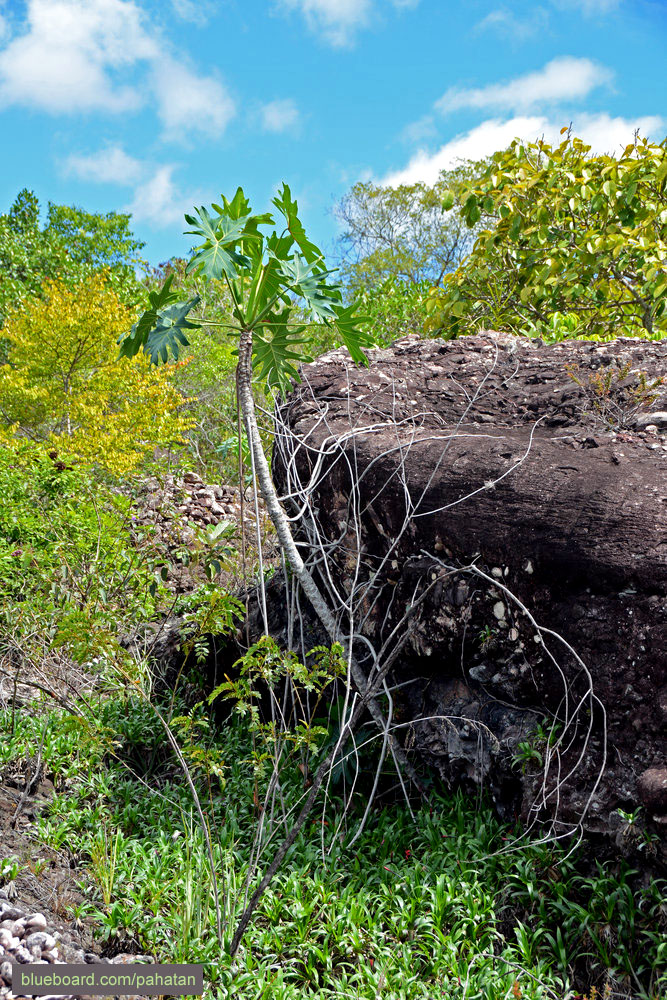
It was but a small step from my infatuation with hemi-epiphytic Philodendrons to Meconostigma aroids. I believe this happened when I realized my large aroids with the beautifully ornamented stems were part of a group called by the somewhat intriguing name of “Meconostigma”. People may think this small group to be archaic remnants of some older times, the more primitive branch compared to their other Philo brethren, but I see them instead as wonderful examples of arborescent hemi-epiphytes, able to “stand” on their own stem when needed, but also able to climb adroitly up the steepest trees and/or buildings when they so desired, their huge leaves unfurled like wavy sails in a vast green sea.
A new twist to the story of my infatuation with these arborescent aroids recently manifested itself when I read two papers.
The first paper I read studied the origins of the Cerrado, the vast tropical savanna that covers more than 2 million km2 and spans three different countries (Brazil, Bolivia, and Paraguay). A look at the evolution of the many Cerrado non-grass lineages found that the estimated ages of Cerrado lineages span the late Miocene to Pliocene from 9.8 to 0.4 mya (million years ago), with the majority less than 4 mya, a time span that coincides with the rise of the C4 grasses and the spread of tropical savanna biomes around the world (Simon et al, 2009).
Based on their findings, it seems that the species endemic to the Cerrado had diversified from the flora in the surrounding forests due to the formation of the newly-formed biome. They were fire adapted and would not have arisen without the spread of the dominant fire-loving C4 grasses.
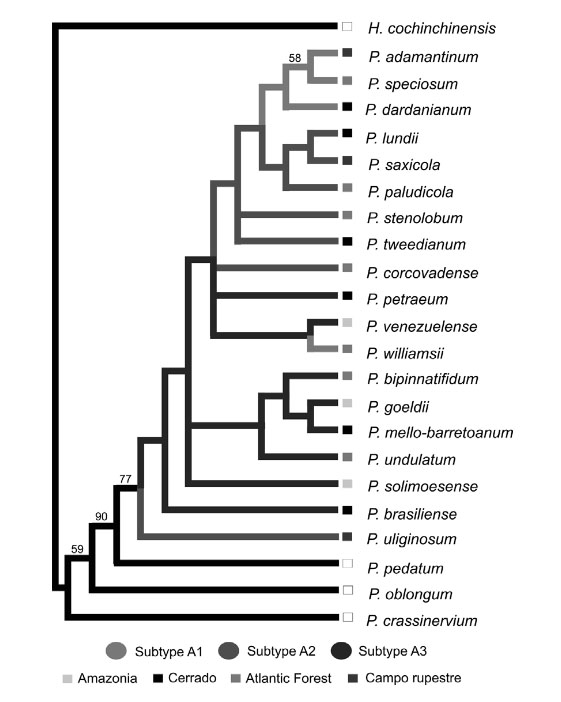
The second paper I read was focused on delineating the phylogeny of the Thaumatophyllum, of which there are around 21 species (species count varies based on source). It found that the basal species in the genus are Thaumatophyllum brasiliense and Thaumatophyllum uliginosum, both of which are grassland dwellers. More specifically, T. brasiliense is from the campo rupestre and T. uliginosum is from the Cerrado (Calazans et al, 2014). The campo rupestre is a rupestrian grassland that occurs in the montane subtropical regions of several biomes, including the Cerrado, the Atlantic Forest, and the Caatinga.
If true, then this suggests that the ancestral species of the genus originated when the C4 grasses first proliferated and pushed aside the forests to create the extensive tropical savannas several million years ago. From these grasslands, the lineage diversified over time and some species moved into the surrounding forests and other less open biomes. In the most literal sense, without C4 grasses and the grasslands that they formed, the evolution of these spectacular arborescent aroids might not have occurred, and the world would have been so much poorer for it.
So, in the words of Stephen King, I say thankya C4 grasses, for helping create the one of the coolest and most beautiful aroids that I and many others have had the pleasure of growing and appreciating.
Literature Cited
Calazans Luana Silva Braucks, Cassia Mônica Sakuragui, Simon Joseph Mayo (2014). From open areas to forests? The evolutionary history of Philodendron subgenus Meconostigma (Araceae) using morphological data, Flora – Morphology, Distribution, Functional Ecology of Plants, Volume 209, Issue 2: Pages 117-121
Simon MF, Grether R, de Queiroz LP, Skema C, Pennington RT, Hughes CE (2009). Recent assembly of the Cerrado, a neotropical plant diversity hotspot, by in situ evolution of adaptations to fire. Proc Natl Acad Sci U S A. Dec 1;106(48):20359-64. doi: 10.1073/pnas.0903410106. Epub 2009 Nov 16. PMID: 19918050; PMCID: PMC2787167.
Leave a Reply