
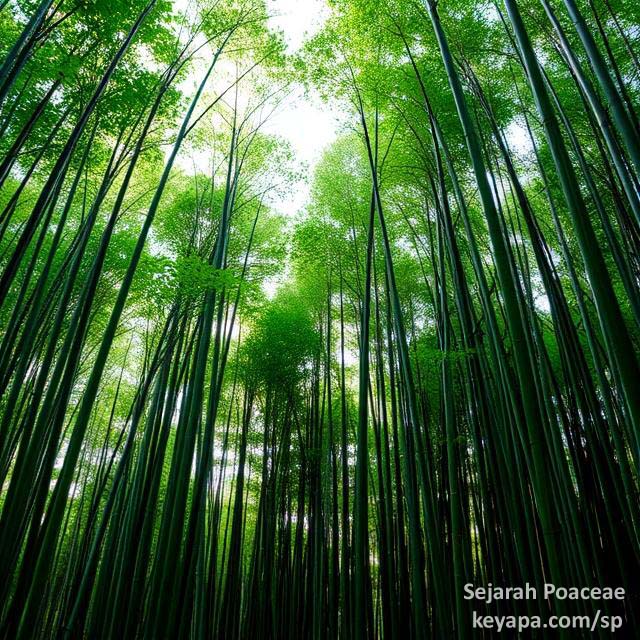
Conclusion: Bamboos are not trees, and bamboo “forests” are not forests, but are a type of grassland.
Globally, there are about 30 million ha of land that are marked as “bamboo forests” (Hu et al, 2018). This does not seem to include large areas where bamboo species are strongly dominant below taller woody trees as a continuous layer in the understory. For example, shade-tolerant species of the mountain bamboo genus Chusquea are dominant throughout South American forests and heavily influence forest dynamics of the taller trees (Guerreiro, 2025; Veblen, 1982).
I joined a discord server dedicated to the podcasts Common Descent and Leaf it to Us, and an interesting topic was whether bamboo forests are actually grasslands.
In order to answer this question, we would at first need to agree on what constitutes a forest.
Brittanica defines it as a complex ecological system and natural resource in which trees are the dominant life-form.
National Geographic notes down that a forest is an area that has a large number of trees.
The UN-REDD is more precise, and chimes in that it is an area of land spanning more than 0.05 hectares with tree crown cover (or equivalent stocking level) of more than 10 percent with trees with the potential to reach a minimum height of 2-5 meters at maturity in situ.

In all the definitions for “forests” that I found, the main component of a forest are trees, which then pushed me to find some definitions for “trees”.
In this case, there seems to be more variability, with some confusion as to the delineation between “trees” and “shrubs”, although this does not really affect the bamboo questions.
Merriam-Webster defines a tree as a woody perennial plant having a single usually elongated main stem generally with few or no branches on its lower part.
Brittanica notes that a tree is a woody plant that regularly renews its growth (perennial). Most plants classified as trees have a single self-supporting trunk containing woody tissues, and in most species the trunk produces secondary limbs, called branches.
In most definitions, one of the primary characteristics is that it is a woody plant, which then begs the definition of “wood” and “woody plants”.
A university site describes wood as secondary xylem consisting largely of dead cells involved in the transport of water and minerals as well as support.
Another university site notes that a tree is a plant with woody tissue, and wood is produced by the cambium layer (a layer of secondary meristematic tissue).
It is at this point that we can finally answer our questions.
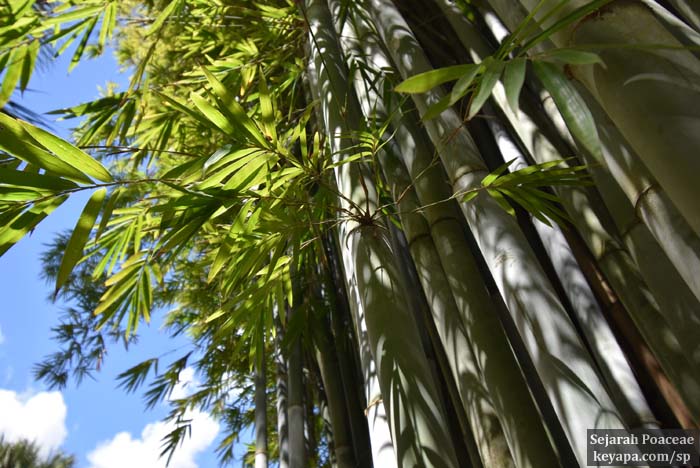
It is a fact that bamboos are grasses which do not have a cambium layer. The width of a bamboo culm as it surges up from the ground will basically be the same throughout its rise to its final height.
Therefore bamboos do not have “wood”, and going by the definitions above are thus not “trees”.
If bamboos are not trees, then by definition, bamboo clusters cannot be strictly thought of as “forests”.
Finally, since “grasslands” are defined as an area in which the vegetation is dominated by a nearly continuous cover of grasses, and since bamboos are grasses, then bamboo “forests” by definition are a type of grassland 😉
Literature Cited
Guerreiro C, Nicolás F Brignone, Lynn G Clark, Andrea S Vega, A trip of a bamboo lifetime: tracing the origin and evolution of Chusquea (Poaceae, Bambusoideae, Bambuseae) in Patagonia, southernmost South America, Botanical Journal of the Linnean Society, Volume 207, Issue 4, April 2025, Pages 308–320, https://doi.org/10.1093/botlinnean/boae048
H. Du et al., (2018). “Mapping Global Bamboo Forest Distribution Using Multisource Remote Sensing Data,” in IEEE Journal of Selected Topics in Applied Earth Observations and Remote Sensing, vol. 11, no. 5, pp. 1458-1471, May 2018, doi: 10.1109/JSTARS.2018.2800127
Veblen Thomas (1982). Growth Patterns of Chusquea Bamboos in the Understory of Chilean Nothofagus forests and Their Influences in Forest Dynamics. Bulletin of the Torrey Botanical Club Vol. 109, No. 4 (Oct. – Dec., 1982), pp. 474-487 (14 pages)


Leave a Reply