
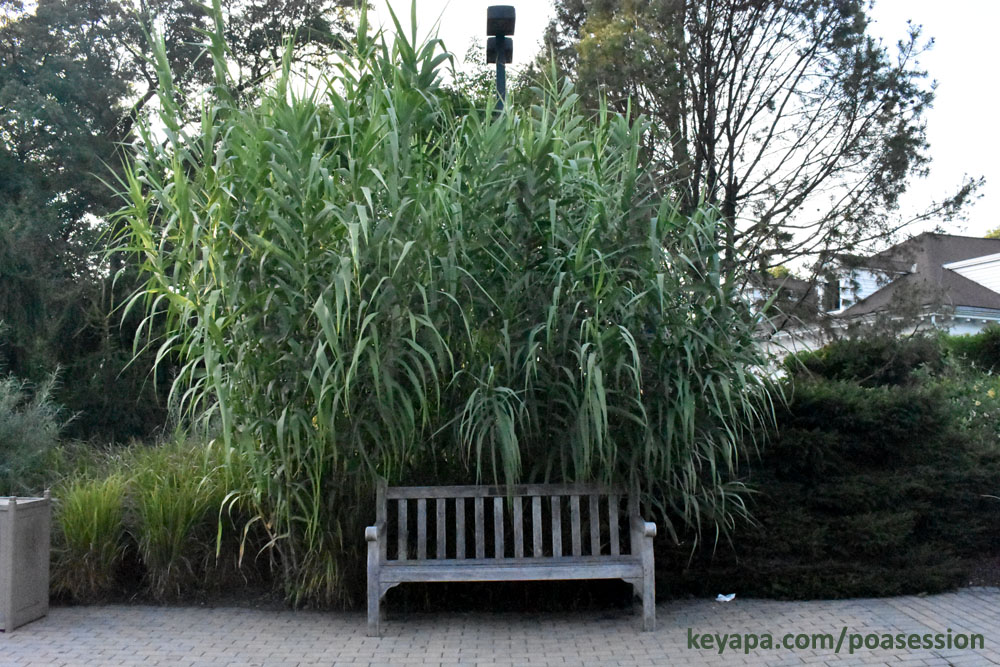
In the 1960s, and extending into the 1980s, large-scale government efforts to eradicate fire ants (Solenopsis invicta) in the United States of America failed miserably. This was in my thoughts as I read a fascinating and well-researched piece about efforts by the government to contain an invasive grass called Arundo donax in Texas, because even in this relatively small scale effort, the combatants have been unable to make headway against the grass.
Arundo donax is a very large species that is a member of the subfamily Arundinoideae, and as befits its prominent presence, it has a range of common names, including giant cane, elephant grass, carrizo, arundo, Spanish cane, Colorado river reed, wild cane, and giant reed. Like all the other members of the Arundinoideae (and unlike many members of the PACMAD clade of the Poaceae), it uses C3 photosynthesis.
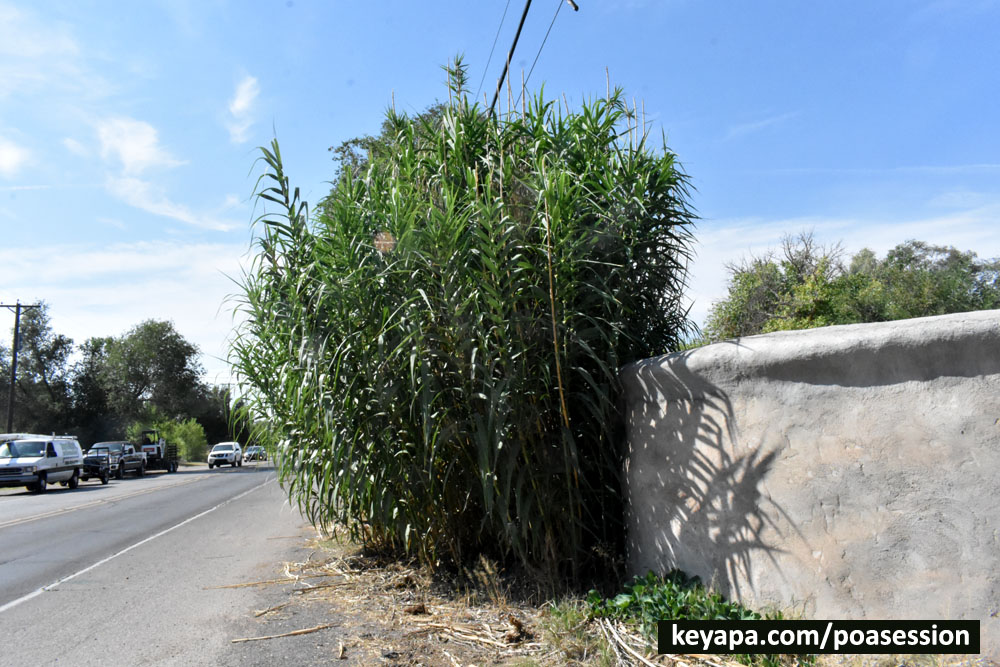
This perennial grass that was introduced in the 1800s into the USA is an invasive par excellence in riparian areas, using its fast growth and tall stature to form monotypic stands to push out native species (including trees). It also increases fire risk and disrupts the hydrology of places that it invades.
In the Texas border, its presence facilitates movement of undocumented immigrants, and so its removal was given high priority by the government. But even in such a relatively small scale project, controlling it has become very difficult. Not only due to the innate pervasiveness and verdant nature of the grass, but also due to human bureaucracy, coordination problems and competition between agencies, underfunding, and other legal problems such as the sorting of border disputes.
The problems controlling a large grass in this relatively small area highlights the near impossibility of eradication (or maybe even controlling the spread) of other invasive grasses elsewhere.
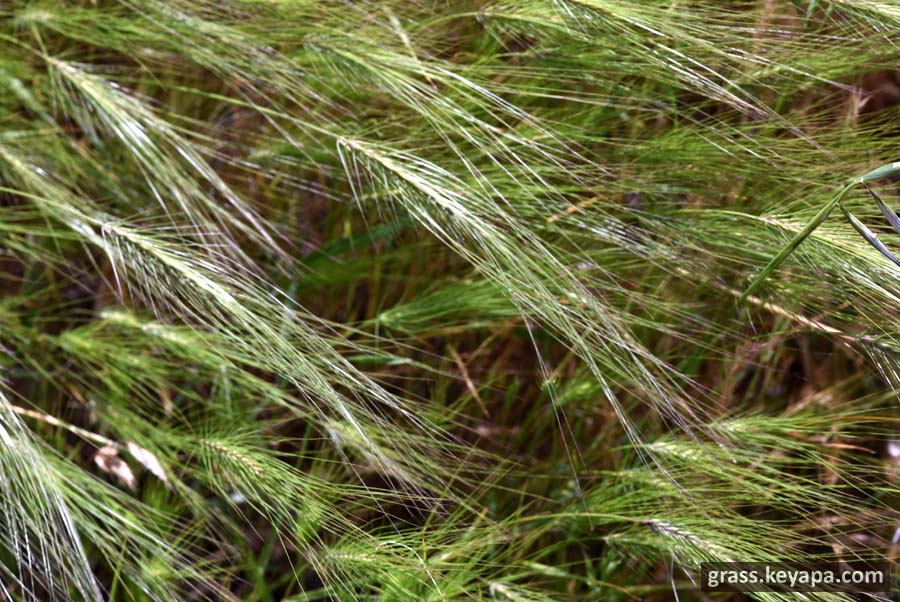
For example, the spread of annual invasive grasses like Taeniatherum caput-medusae (medusahead grass), Bromus tectorum (cheatgrass), and Ventenata dubia into the sagebrush ecosystem in the Great Basin of the Western USA has been nothing short of a calamity. These grasses already occupy more than 62 million hectares of land, and are reportedly expanding at a rapid pace of 200,000 ha every year (Smith et al, 2021). This rate of expansion per year is a mind boggling number, because it is an area that is twice the size of Los Angeles and nearly triple the land area of New York City. It dwarfs by orders of magnitude the eradication of A. donax in the Texas border area.
I can only imagine that efforts to eliminate them are impossible, but the hope now is that states can coordinate to at least limit or delay their spread into native, uninvaded areas. This massive effort has been termed Defend the Core (see video above).
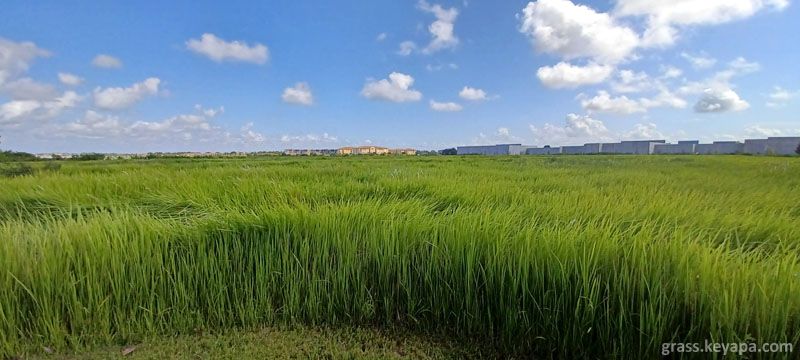
The same holds true for another invasive grass, Imperata cylindrica. This PACMAD species is noted as being one of the top weeds in the world. In the tropics there are whole mountain ranges covered in cogon, and estimates state that it may dominate up to 4% of the total land mass of tropical Asia. In some places like Sri Lanka, cogongrass covers a up to 23% of the country, and worldwide it may infest up to 500 million hectares, an area nearly the size of the total land of the continental USA.
Although it is limited to the subtropical southeastern parts of the USA, where it covers about half a million hectares, it is near impossible to even think about eradicating it from the country. However, there have been some success in keeping non-invaded areas relatively clear through continuous monitoring and spraying against newly-discovered loci of infestations.
My pessimism about our ability to control and eradicate widespread invasive grasses stems from the fact that the Poaceae exhibit a suite of invasive traits that when taken together, researchers have termed the “Viking Syndrome” (Linder et al, 2018).
These traits include efficient dispersal, rapid population growth, environmental flexibility, flexible growth forms/phenotypic plasticity, and the ability to transform environments to benefit themselves.
Taken together, these imbue grasses with an unmatched ability to aggressively colonize and settle into new lands, and enables them to withstand all our efforts to eliminate or even control their spread.
Literature Cited
Linder, H.P., Lehmann, C.E., Archibald, S., Osborne, C.P., & Richardson, D.M. (2018). Global grass (Poaceae) success underpinned by traits facilitating colonization, persistence and habitat transformation. Biological Reviews, 93.
Smith, J.T., Allred, B.W., Boyd, C.S., Davies, K.W., Jones, M.O., Maestas, J.D., Morford, S. L., Naugle, D.E., 2021. The elevation ascent and spread of exotic annual grasslands in the Great Basin, USA. bioRxiv 2021, 425458
Leave a Reply