

In a previous post we found out how Guadua tropical bamboos carve out their territories and spread against trees by physically damaging them using heavy water-filled culms. These tropical bamboos have pachymorph (or sympodial) rhizomes that are relatively short, and thus are so-called “clumping” types that only expand slowly.
But in temperate areas, researchers found that the strategies used by bamboos are different. Many bamboos here have thinner and much longer leptomorph (or monopodial) rhizomes which allow them to spread over relatively longer distances quickly. These are thus called “running” bamboos, and the way they expand their territories into forests differs significantly from that used in tropical clumping bamboos.
In these temperate bamboos like Phyllostachys edulis (“moso bamboo”), their fast vertical growth and rapid horizontal movement via rhizomes are important factors that enable their expansion. But clonal integration is the essential ingredient in the mix.
The first thing to note is that culms that grow up from the horizontal rhizomes are genetically identical clones that are each called “ramets”. These ramets are fully developed plants, and the can function as individuals when separated if the rhizome is severed. The entire cluster of ramets is called a “genet”.
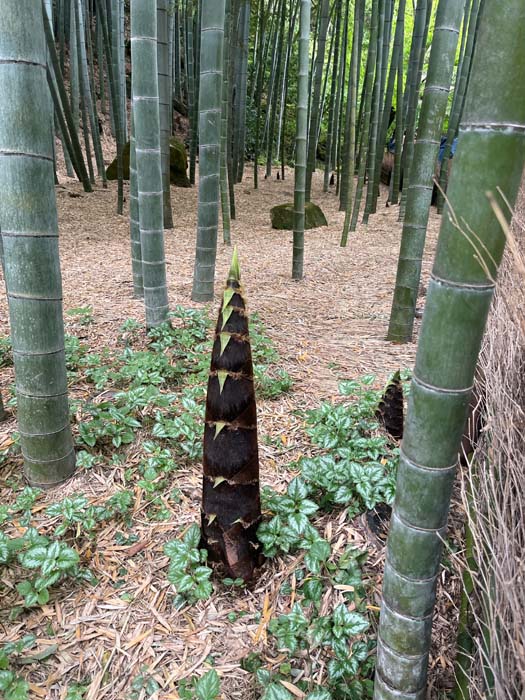
Researchers have found that nutrients and water can be translocated throughout the entire network of ramets. This ability to share information and other materials between them is called “clonal integration”, and it allows temperate bamboos like Phyllostachys spp to spread at the expense of trees.
In one case, a bamboo forest in Tokyo slowly engulfed secondary tree forests using its vigorous rhizomes to invade the forest and then slowly replace trees as they got damaged by strong winds and accumulating snow (Okutomi et al, 1996). In a more natural setting, researchers at the Tianmu Mountain Nature Reserve (TMNR) of Zhejiang Province in southeastern China documented the expansion of P. edulis into forests at a rate of 4.47 ha per year between 1985 and 2003, and also at 7.8 and 26.1 ha per year during the last two decades. Overall in China, bamboo forests grew in size by 113% from 3.00 Mha in 1972 to 6.41 Mha in 2018 (Zheng and Lv, 2023).

These expansions are enabled by clonal integration, vigorous rhizomatous spread, and the fast vertical growth of bamboo culms. Researchers found that Phyllostachys edulis culms occur at a higher density close to the border between the bamboos and trees. These culms send rhizomes into the forest, where the dim light does not allow most plants to thrive (Zheng and Pacala, 2024). Remarkably, bamboo ramets outside the dim forest will support the invading rhizomes by translocating photosynthate to them.
The ramets in the forest will bide their time until some natural event topples or removes the surrounding trees (bamboos are seemingly more immune to high winds and accumulating snow than trees for example), and when that happens the bamboos will spring into action, growing at rates that cannot be matched by young trees and seedlings. Once the invading culms have reached canopy height, it’s all over, as the dense ramets deny sunlight to the juvenile trees below. In this way, temperate bamboos can slowly but inexorably expand into forested areas.
Literature Cited and References
Okutomi, K., Shinoda, S. and Fukuda, H. (1996), Causal analysis of the invasion of broad-leaved forest by bamboo in Japan. Journal of Vegetation Science, 7: 723-728. https://doi.org/10.2307/3236383
Zheng, Aiyu, and Stephen W. Pacala. 2024. “ The Enigmatic Life History of the Bamboo Explained as a Strategy to Arrest Succession.” Ecological Monographs 94(4): e1621. https://doi.org/10.1002/ecm.1621
Zheng, A., Lv, J. Spatial patterns of bamboo expansion across scales: how does Moso bamboo interact with competing trees?. Landsc Ecol 38, 3925–3943 (2023). https://doi.org/10.1007/s10980-023-01669-z
Leave a Reply