
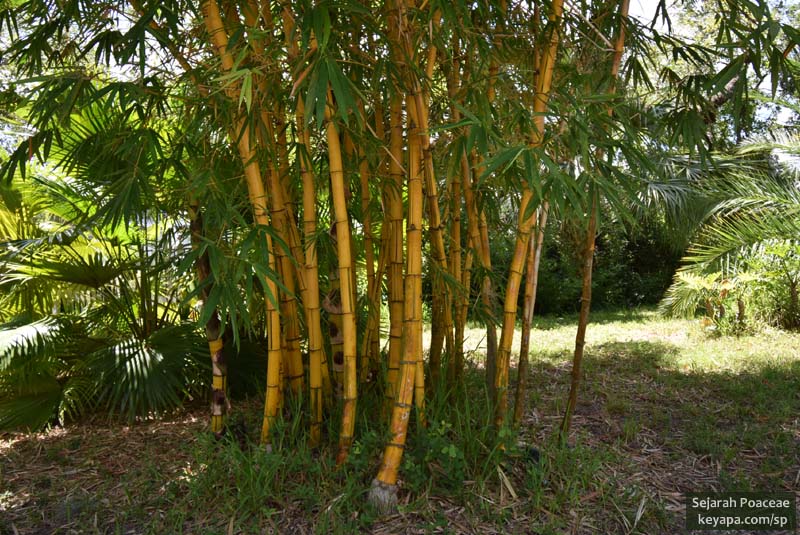
We visited Tampa last weekend, and during a drive along a narrow street I suddenly spotted a vision that made me immediately stop.
It was a tight clump of tall bamboo with stunning colored culms. It rose from the surrounding prosaic neighborhood like a risen golden angel, the attractive green leaves vibrating in the breeze.
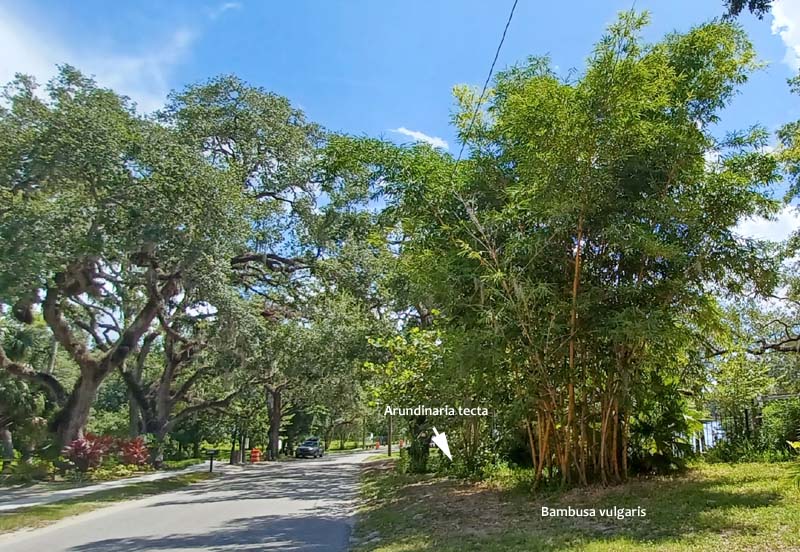
The specimen was Bambusa vulgaris ‘Vittata’, which is commonly known as ‘Painted Bamboo’ (of the subfamily Bambusoideae). B. vulgaris is a common bamboo with a loose clumping habit that originated in Asia, but has been distributed around the world in both subtropical and tropical regions. It prefers humid conditions and moist soil, but can tolerate more extreme conditions. Interestingly enough, the shoots of this species has an enzyme inhibitor that is highly toxic to human beings, although boiling will quickly render it harmless.
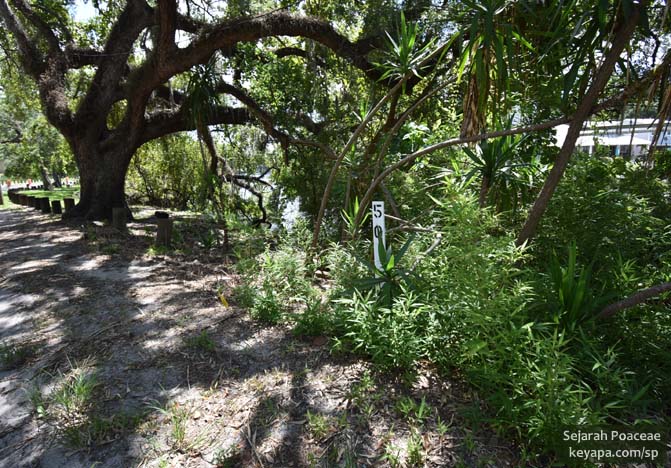
It was while taking pics of the ornamental bamboo that I happened by accident upon a plant that was almost right next to it, and was even more interesting to me. It was another bamboo, but the difference between the two species could not have been more stark. Whereas the much larger clumping B. vulgaris has a sympodial or pachymorph growth habit, with compact rhizomes remaining close to the original base, this short specimen seemed to be growing out and spreading, likely via underground rhizomes.
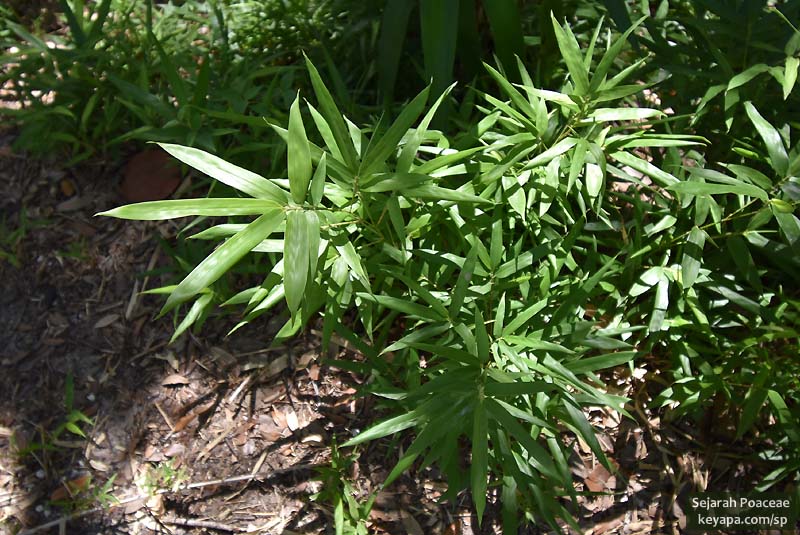
I tagged the plant as Arundinaria tecta, a native bamboo locally known as switch cane whose distribution is the eastern USA from Virginia to Florida. Unlike its golden-skinned imported neighbor, A. tecta has a monopodial or leptomorph growth form, with rhizomes that run underground and allows it to spread vegetatively.
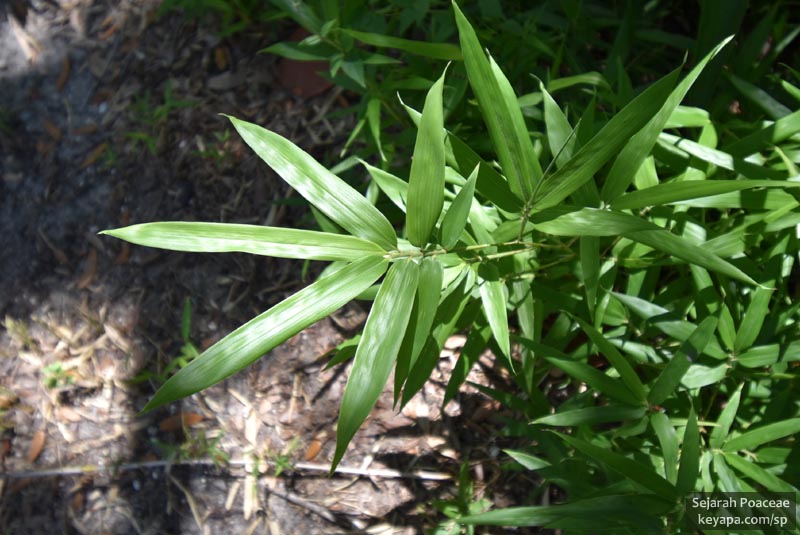
Several hundred years ago, the Arundinaria spp (especially A. gigantea) formed dense tracts of monotypic vegetation called canebrakes across the land, from the Mississippi river to the Atlantic coast. Some estimates say that up to 4 million ha were covered by these canebrakes. Indigenous peoples at the time learned to make use of these, even harvesting the seeds to provide nutritious food. They also used it as a building material for weapons and shelter. In addition, canebrakes housed a large variety of native animals, some of which are extinct or endangered. In one study, 236 species were found within a single canebrake in South Carolina (Gray et al, 2016)!
However, the vast majority of these canebrakes were cleared or were denuded by the new domesticated animals brought by European settlers who arrived. The loss of a regular fire regime also impacted their survival, as Arundinaria sp can maintain themselves in the shade of forests until fire clears the way for them to suddenly dominate.
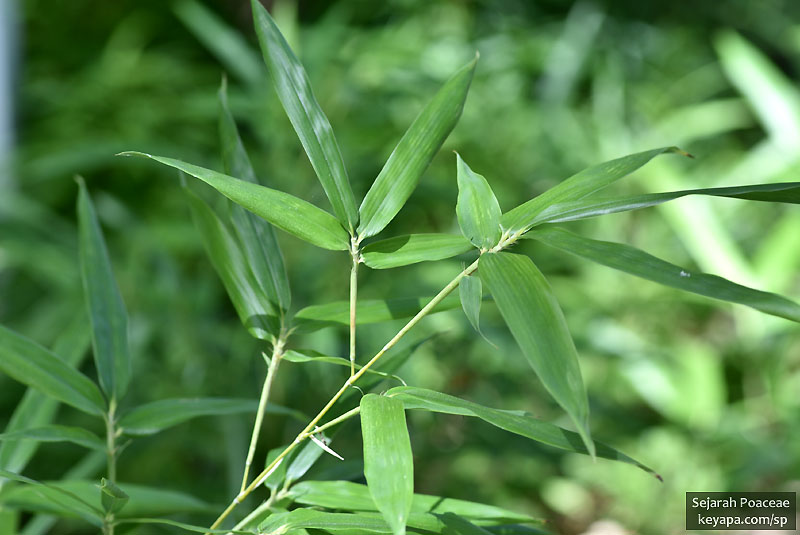
The specimens I found of A. tecta were under the shade of a large tree next to the Hillsborough River. The cluster occupied an area roughly 10 sqm, and there were signs that it had been recently maintained, with cut stems littering the ground. However, the cluster looked healthy, with dark green leaves and lots of new culms sprouting from the moist ground. Its ramets dominated the small area, and the recent clearing probably indicated vigorous growth. Indeed, a quick look at Google Street view from July 2024 showed that the cluster at the time formed a large, seemingly impenetrable, hedge along the roadside. No wonder the residents had elected to trim it drastically!

Still, I doubt that most of the local people even gave it a second glance. Although the leaves were very attractive and well-formed, its appearance paled before the magnificent B. vulgaris, and one could be forgiven for thinking it was just a common (at times, overgrown) weed. It would be the height of irony if at some future date, when man has somehow passed away like some bothersome weed on the land, that these former masters of the earth might again rise to claim their former dominance.
Literature Cited
Gray, Janet Bracey; Sorrie, Bruce A; Wall, Wade (2016). “Canebrakes of the Sandhills Region of the Carolinas and Georgia: Fire History, Canebrake Area, and Species Frequency”. Castanea. 81 (4): 280–291.
Leave a Reply