

In a post last year, we looked at how grasses shaped human evolution, which included changing the shape of our skulls and perhaps even the color of our skin. But the tight partnership between people and grains that started with the advent of agriculture, affected many things beyond just the human phenotype.
There have been numerous studies that purport to show that hunter gatherer societies were and are more egalitarian, although there was still the notion that men hunted and women foraged. But even this idea has been challenged, with some studies stating that women also hunted along with the men.
For example, a burial in Peru was discovered where a female was buried along with many hunting tools and implements, which normally is an indication that the women was a hunter (Haas et al, 2020). In addition, a study on current foraging societies found that women hunt in 79% of the societies, with big-game hunting occurring in 33% (Anderson et al, 2024).
There has been some pushback to the relatively recent claims that foraging cultures have weak or even no gendered division of labor. But even these admit the existence of relatively flexible gender roles (Venkataraman et al, 2023).
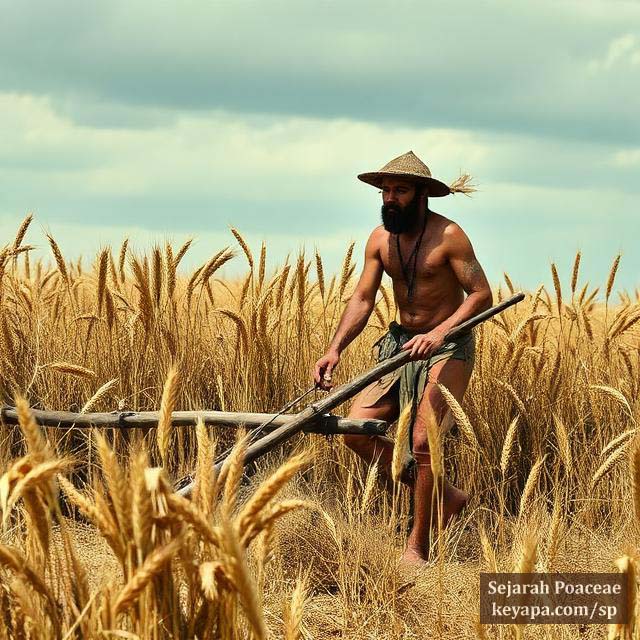
This status quo changed around 8000 BCE, when the Neolithic Revolution started the path towards societies where strict gender roles were solidified. This onset of grain agriculture created a distinct separation between genders, where men did field work, and women were limited to home-based and reproductive tasks.
This division of labor was created because the use of plows necessitated much greater upper body strength, a trait that men possessed. Control of the fields and thus the means of production increased the economic power of men, marginalizing women and relegating them mostly to work in and near the homes.
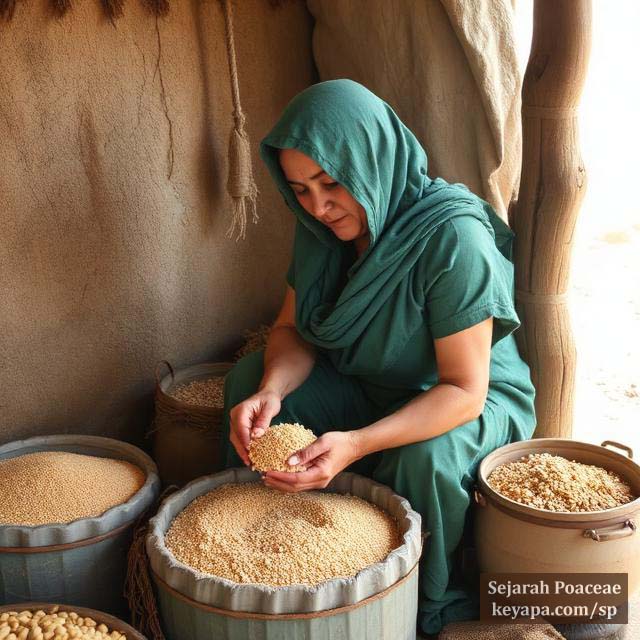
Interestingly enough, studies have found that societies with long histories of agriculture also tend to have stronger and stricter gender roles. That is, there seems to be a negative relationship between length of agricultural history and female participation in the workplace, politics, and other measures (Alesina et al, 2013; Hansen et al, 2015).
But no matter how you look at it, the advent of the tight partnership between cereal grasses and humans had profound effects on the development of human societies. Our world literally would not be the way it is today without the Poaceae.
Literature Cited
Alberto Alesina, Paola Giuliano, Nathan Nunn, On the Origins of Gender Roles: Women and the Plough , The Quarterly Journal of Economics, Volume 128, Issue 2, May 2013, Pages 469–530, https://doi.org/10.1093/qje/qjt005
Anderson A, Chilczuk S, Nelson K, Ruther R, Wall-Scheffler C (2024) The Myth of Man the Hunter: Women’s contribution to the hunt across ethnographic contexts. PLOS ONE 19(8): e0309543. https://doi.org/10.1371/journal.pone.0309543
Haas R, Watson J, Buonasera T, Southon J, Chen JC, Noe S, et al (2020). Female hunters of the early Americas. Science Advances. 6(45):eabd0310. pmid:33148651
Hansen, C.W., Jensen, P.S. & Skovsgaard, C.V. Modern gender roles and agricultural history: the Neolithic inheritance. J Econ Growth 20, 365–404 (2015). https://doi.org/10.1007/s10887-015-9119-y
Vivek V. Venkataraman, Jordie Hoffman, Kyle Farquharson, Helen Elizabeth Davis, Edward H. Hagen, Raymond B. Hames, Barry S. Hewlett, Luke Glowacki, Haneul Jang, Robert Kelly, Karen Kramer, Sheina Lew-Levy, Katie Starkweather, Kristen Syme, Duncan N.E. Stibbard-Hawkes (2023). Female foragers sometimes hunt, yet gendered divisions of labor are real
Leave a Reply