
|
Pulang ---> Rencana-Rencana ---> On the discovery of the natural hybrid Thaumatophyllum Marijke (spruceanum x solimoesense) On the discovery of the natural hybrid Thaumatophyllum Marijke (spruceanum x solimoesense)Last Edit: 2018/8/9 This article was originally printed in The IAS Newsletter, Vol 38 No. 4, from December 2016. It is posted with permission from Joep Moonen, who contributed the images as well. I have kept the original binomial nomenclature of "Philodendron x" 
Fruits, without seeds on a fully grown Philodendron "Marijke" plant. In 1995, during an impact study, a boat had to bring me to the other side of the Cavalet River in eastern French Guiana, close to the border with the State of Amapa, Brazil. Waiting for the boat, looking at the trees, I saw a large Philodendron in one of the neaby tree trunks. It was a big Meconostigma, but the leaf form was neither Philodendron goeldii nor P. solimoesense. Was it another species, perhaps undescribed? 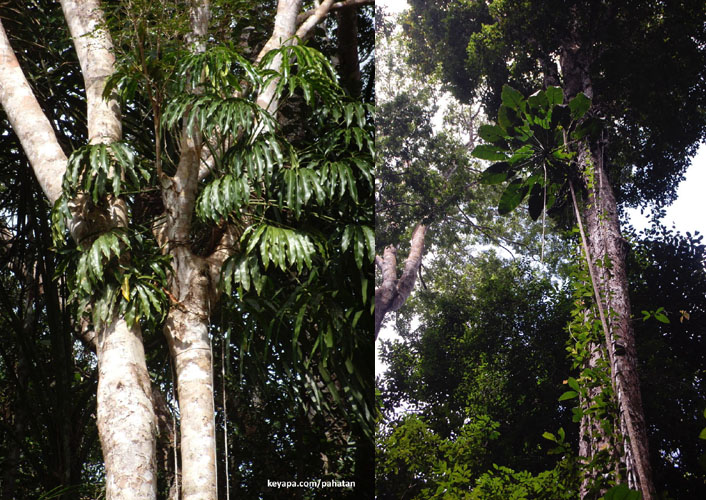
Thaumatophyllum spruceanum and Thaumatophyllum solimoesense 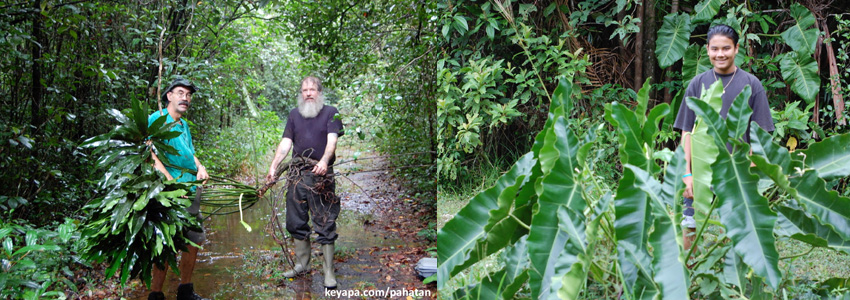
Joep Moonen, Piet Bongers collecting Thaumatophyllum spruceanum, Kaw Mountains, French Guiana; and Bernie Moonen with Thaumatophyllum solimoesense, Emerald Jungle Village, French Guiana A surprise in Holland In 1997 I sent a couple of hundred seeds of home-grown Philodendron goeldii to my friend Peter Bak from BAK Bromeliads in the Netherlands. After some months when the seedlings changed leaf form, Peter wrote me that what I sent were not P. goeldii. I checked my outcome from the same fruits, and indeed, the leaves appeared strange, more solid than palmate. Strange, since I was sure, I collected the fruits from a big Philodendron goeldii plant at our porch. Philodendron solimoesense grew there, too, but they have orange, almost red and smaller fruits. The fruits of P. goeldii are yellow and you cannot confuse them with fruits of P. solimoesense. 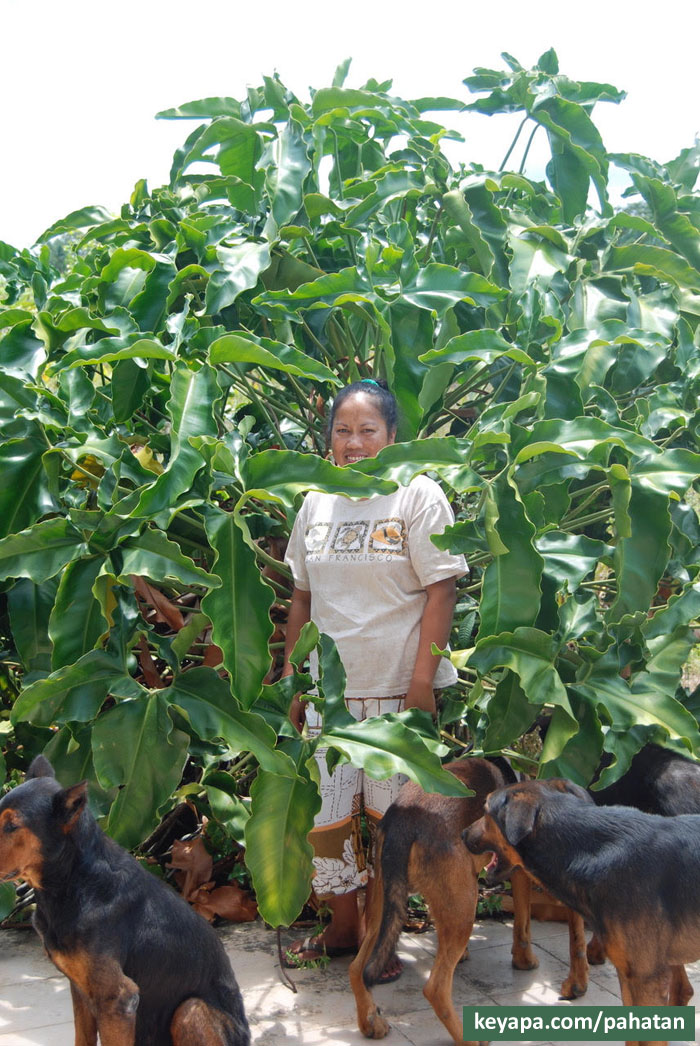
Marijke Moonen and our Beauceron dogs posing for the first fully grown Philodendron 'Marijke', Emerald Jungle Village, French Guiana Since we live in the natural enviroment of both species, Cyclocephala beetles visit the flowers and obviously pollinated my Philodendron goeldii flower with P. solimoesense pollen! The beetles made a nice hybrid for me. I had planted 100 seeds and 85 made it to bigger pot plants. I called it Philodendron Marijke in honor of my dear girlfriend, life time partner and wife, Marijke. I sold the P. Marijke plants little by little, or traded them for other plants. I kept five plants at our property that grew out to enormous plants, with many branches, flowers and fruits. But fruits from them were without seeds: it is clearly a hybrid. Now I understood also that what I saw in 1995 at Creek Cavalet: in that tree was a Philodendon Marijke, at that time an unknown Meconostigma form. Para, Brazil Some years later, a sympathic botanic explorer, Dr Andre Cardoso of the Emilio Goeldi Museum in Belem, State of Para (Brazil), found the same hybrid during field work in Para. He was so kind to send me pictures, and obviously it is the same hybrid. The same parent species, Philodendron goeldii and P. solimoesense grow in Para too, as well as in many other Amazonian States. 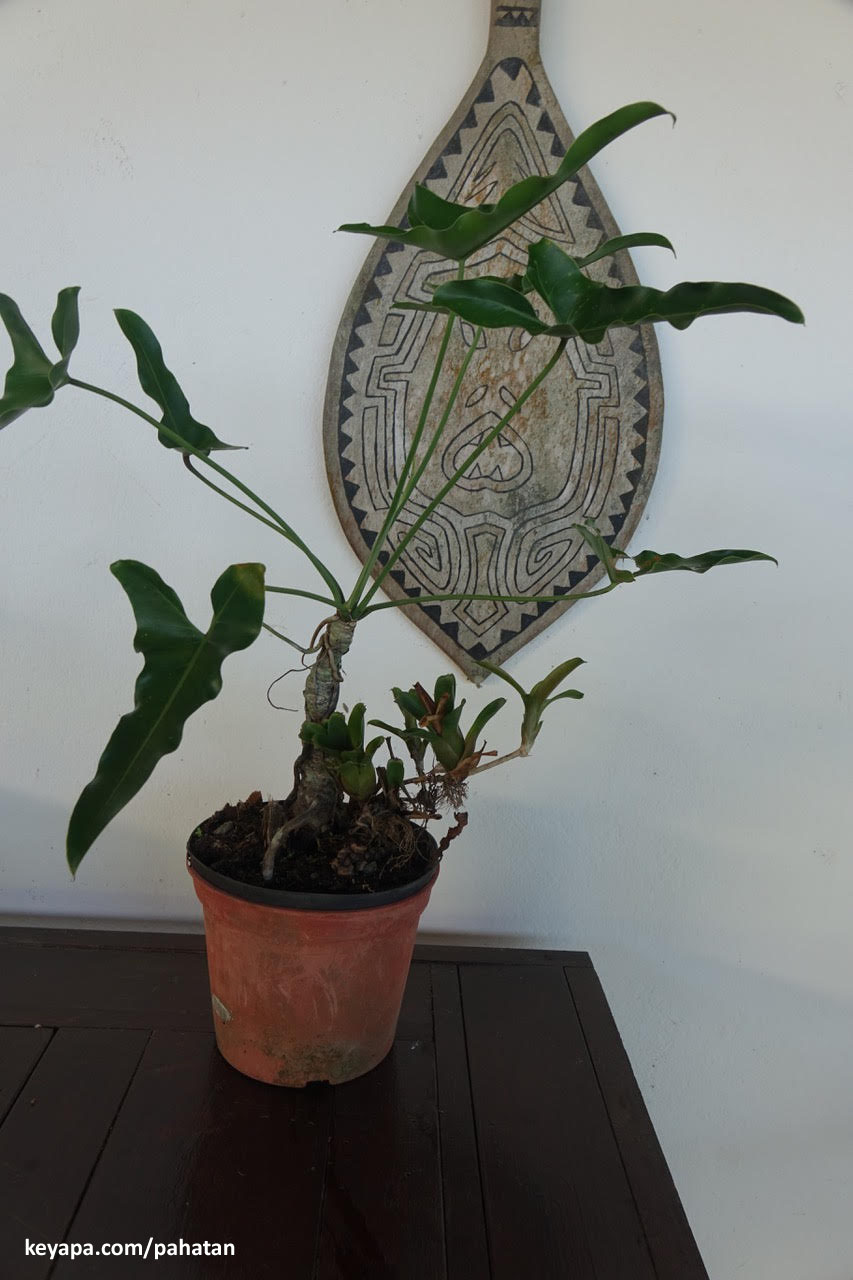
Dwarf plant of nearly 20 years old of Philodendron 'Marijke'. I have plants only as a hobby. Our lodge and excursions sometimes make us really busy. Even if there are no guests, we are busy with the maintenance of the buildings, garden, the forest trail, the boats, canoes, their trailers, communications etc. Sometimes I simply do not have time to look at my plants. But they grow, they don`t need me, since the Amazonian environment here is their natural habitat! My 85 Philodendron 'Marijke's grew and sold well. Then I noticed that a few specimens were behind in growing. After years they turned out to have a growth defect and they remained dwarfs. Now, after almost 20 years I have one left. I call it Philodendron ‘Bonsai’, not correct, since it was not dwarfed by trimming, more likely it remained small due to a genetic defect. The difference in size between the normal Marijkes and the Bonsai is enormous: Normal Marijke stems are 200 – 300 cm long (80” - 120”), Bonsai stems are 20 cm long (8”). Normal Marijke leaves are ca 90 cm long (ca 36”), Bonsai leaves are ca 20 cm long (ca 8”). So far, I have never noticed aroid dwarfs in the wild., although I have noticed dwarf plants blooming in a bromeliad: Aechmea mertensii. This species is extremely variable in size. Another phenomenon to look for on my next fieldtrip |
Penulis: A. Sunjian
Situs persembakan