|
This noble aroid has been for years a well-known ornament of the aquarium near
the Palm House at Kew, growing in a pot, the base of which
is immersed, and forming a crown of bright green foliage,
1.8 m in diameter, and 1.2-1.5 m in height. It was sent to
Kew by Mr. Williams, of Bahia, many years ago, flowers annually,
and would have been published in this magazine ere this, but
for the difficulty of naming the plants of this genus, which
embraces upwards of one hundred and fifty species, many of
them imperfectly described. As however it agrees with none
of those contained in Schott's excellent monograph (1860),
has not since been figured in any publication accessible to
me, and has not been recognized by the many continental botanists
and horticulturists who have seen it at Kew, I am emboldened
to describe it as new, and give it the name of the highly-valued
correspondent who contributed it to our collections.
Trunk 0.6-1.2 m high, 5-7 cm in diameter, branched, brown, covered with suborbicular leaf scars, emitting numerous cylindric brown roots 1.2 cm in diameter.
Leaves numerous, 30-76 cm long, sagittate, bright green, with pale veins above, paler beneath, with dull purple midrib and veins, coriaceous, acute or cuspidate, anterior portion obscurely lobed, with 5-6 pairs of spreading principal veins and innumerable intermediate ones; posterior lobes oblong-ovate, obtuse, costa of this marginal at the base of the sinus only; petiole 60-76 cm long, slender, terete, grooved above, thickened at the base but not at the top, quite smooth, green.
Peduncle axillary, solitary, as thick as the thumb, as long as or shorter than the spathe, green, cylindric.
Spathe approx 30 cm long, convolute, then gaping and boat-shaped, obtuse, apiculate, very thick and herbaceous, green, much thickened but not inflated at the base, where it merges into the peduncle, bright green, paler and yellowish internally.
Spadix about equalling the spathe, stout, cylindric, obyuse, cream-colored, constrictede below the middle, the long upper male portion lolling laterally out of the spathe; lower female part stouter, base oblique and dorsally adnate to the spathe.
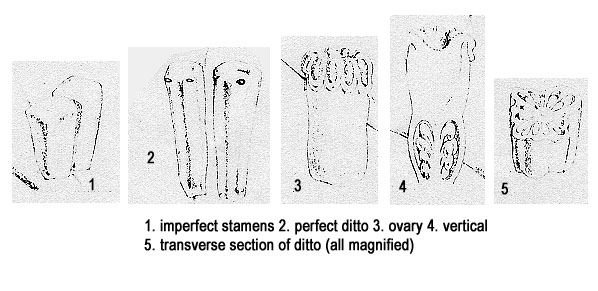
Anthers elongate-obpyramidal, with truncate tips and minute pores.
Ovary obtuse, 4-angled, columnar, many-celled, deeply hollowed out at the top, which is covered with adnate stigmas that are reflected and decurrent on the surface; ovules numerous on each cell.
Oleh: JDH (1891) Botanical Magazine tab. 5899
Dari: Neil Crafter, Julius Boos
|
